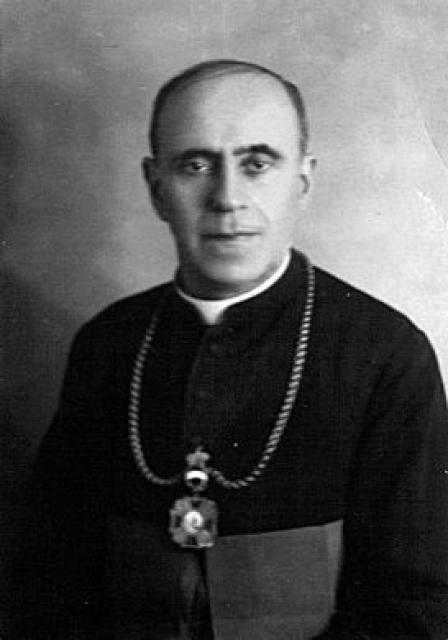
Dionizy Kajetanowicz
 Poland
- The Life of Father Dionysius Kaetanowicz
- Transfer to the Armenian Catholic Rite
- Distinguished Service and Leadership
- Literary and Cultural Endeavors
- Unfulfilled Episcopacy and Martyrdom
- Legacy and Remembrance
The Life of Father Dionysius Kaetanowicz
Early Life and Entry into PriesthoodFather Dionysius Kaetanowicz was born on April 8, 1878, in the village of Tyszkowce, Austrian-controlled Poland (now Ukraine). In 1896, he joined the Franciscan order, taking the religious name Roman. In 1903, he was ordained a priest within the Latin Rite of the Roman Catholic Church by Archbishop Józef Bilczewski of Lviv.
Transfer to the Armenian Catholic Rite
In 1908, Kaetanowicz left the Franciscan order and was incardinated into the Armenian Catholic Rite. He served as cathedral vicar and catechist in the Armenian Catholic Archdiocese of Lviv. From 1912 onwards, he became the pastor of the Armenian Catholic parish in Sniatyn.
Distinguished Service and Leadership
In 1918, Kaetanowicz became an honorary canon and later pastor and dean of the Armenian Catholic parish in Lviv. He also served as a catechist and director of the Armenian Benedictine Sisters' School. In 1933, he received the rank of infula and became vice-president of the Union of Armenians of the Lviv Archdiocese.
Literary and Cultural Endeavors
Kaetanowicz was an accomplished writer and editor. He published research on the history of Sniatyn, a guidebook to the Armenian Cathedral of Lviv, and translated the Armenian liturgy into Polish. He also founded and edited the newspaper "Posłaniec św. Grzegorza" ("Messenger of St. Gregory") and the scientific journal "Gregorianum."
Unfulfilled Episcopacy and Martyrdom
In 1938, the Armenian Catholic Archbishop of Lviv, Józef Teodorowicz, passed away. Kaetanowicz, as cathedral vicar, convened an electoral assembly that overwhelmingly nominated him as one of the candidates for the vacant position. However, the process was interrupted by the outbreak of World War II. Kaetanowicz remained as administrator of the archdiocese but was never consecrated as bishop.
During the war, Kaetanowicz sheltered Jews, an act that led to his arrest by the Gestapo in 1943. The intervention of Archbishop Andrey Sheptytsky saved him from execution. In 1945, he was arrested by Soviet authorities and convicted of "anti-Soviet activities" and "collaborationism." He spent over a decade in prison, writing poetry and religious works until his death in 1954 under mysterious circumstances.
Legacy and Remembrance
Kaetanowicz's unwavering service and sacrifice are remembered today. A symbolic grave can be found in the Rakowicki Cemetery in Krakow, Poland. His image as St. Matthew the Evangelist can be seen in a fresco in the Armenian Cathedral of Lviv, painted by the Polish artist Jan Henryk Rosen. Kaetanowicz's legacy continues to inspire and uplift the Armenian Catholic community and beyond.




