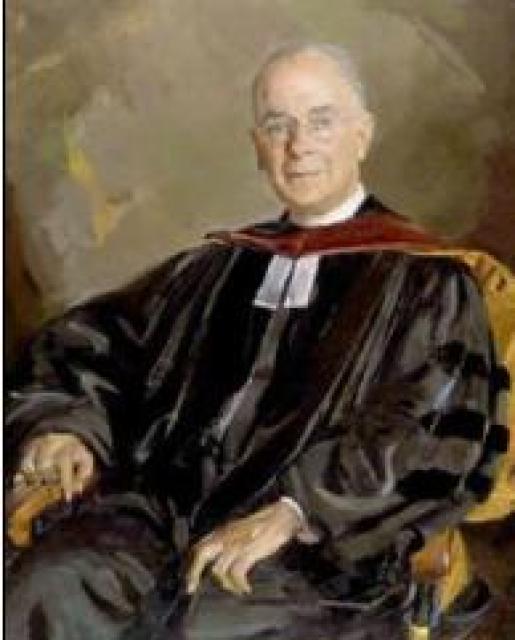
Douglas Horton
 USA
USA- American priest and scholar
- Early Life and Education
- Unifying Christian Churches
- Leadership and Achievements
- Later Years and Legacy
American priest and scholar
Douglas Horton was an American priest and scholar, known for his work on ecumenical relations between the major Protestant movements of his time. He was considered one of the most important religious figures of his era, recognized not only in his country but also beyond its borders. Horton dedicated his work to exploring the unifying role of religion and seeking common ground among people of different nationalities and even faiths.
Early Life and Education
Horton became a priest in 1915, after studying at Princeton University and Hartford Seminary. He initially worked as an assistant pastor at the First Congregational Church in Middletown, Connecticut, and later became a full-fledged priest. Horton also served in Brookline, Massachusetts, and Chicago, where he became deeply interested in the relationships between different religious schools. He began studying the existing movements in the United States, which eventually led to the creation of the National Council of Churches and its worldwide counterpart, the World Council of Churches.
Unifying Christian Churches
Horton argued that Protestant churches were originally separated from other Christians due to relatively minor theological differences and more significant ethnic and socio-economic disparities. However, he believed that now, as these differences had largely been overcome, there was no reason to artificially cultivate this division. Instead, he advocated for the creation of a strong unified Christian church that would benefit all its members. According to Horton, the main goal of this unified church should be the spiritual enrichment of the world and the fight against growing indifference, hostility, and poverty.
Leadership and Achievements
Horton gained authority among representatives of most religious movements of his time. In 1938, he was appointed as the General Secretary of the National Council of Churches, giving him the power to make decisions that could influence the activities of religious institutions throughout the country. He used his authority wisely, with his greatest achievement being the successful merger of his school with the Presbyterian, Evangelical, and Reformed churches. While the idea of such a merger had been proposed in the early 1930s, it was only realized in the 1940s, largely thanks to Horton's efforts.
Later Years and Legacy
Horton did not live to see the completion of the merger; it was finalized by his successor, Reverend Fred Hoskins. After leaving his position as General Secretary, Horton became the Dean of Harvard Divinity School in 1955. At Harvard, he continued to work on issues of inter-church interaction, which were also addressed in the curriculum of his faculty. Horton retired from Harvard in 1960 and passed away eight years later, after spending his well-deserved retirement. His contributions to ecumenism and his emphasis on unity and understanding among different Christian denominations continue to influence religious dialogue and cooperation to this day.




