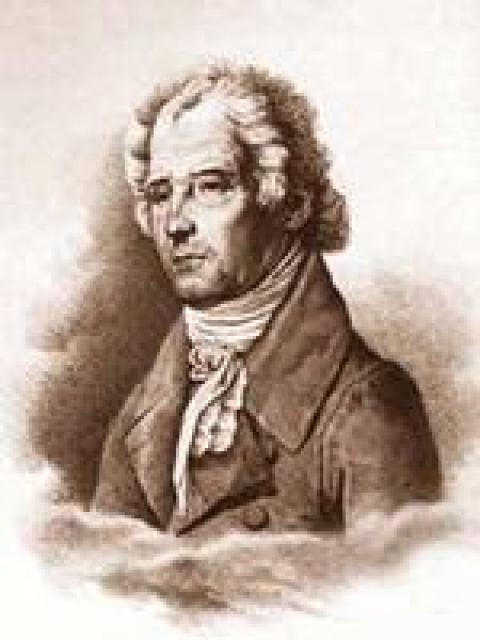
Dmitrij Bornianskij
 Ukraine
- Dmitry Stepanovich Bortnyansky: Russian Composer and Choral Director
- Musical Education and Travels
- Italian Sojourns and Operatic Success
- Return to Russia and Appointment as Court Composer
- Transforming the Court Choir
- Influence on Russian Church Music
- Other Musical Works
- Legacy and Reception
Dmitry Stepanovich Bortnyansky: Russian Composer and Choral Director
Early Life and CareerDmitry Stepanovich Bortnyansky was born in the town of Glukhov, Ukraine, in 1751. At the tender age of seven, he was admitted into the Imperial Court Choir in Saint Petersburg. Despite his primary role as a choirboy, Bortnyansky also gained experience as a soprano soloist, performing in operas. He simultaneously received theatrical training at the prestigious Shlyakhetny Kadetsky Korpus.
Musical Education and Travels
Upon the arrival of Italian composer Baldassare Galuppi as court opera and ballet composer, Bortnyansky became his student. Galuppi's influence had a significant impact on his musical development. In 1768, Bortnyansky was sent abroad to Italy at the expense of the state to continue his education under Galuppi in Venice.
Italian Sojourns and Operatic Success
During his time in Italy, Bortnyansky composed prolifically, writing several major works such as operas, cantatas, and sonatas. His operas, including "Creonte" and "Alcide," were performed on Italian stages. He also visited other Italian cities such as Florence, Bologna, Rome, and Naples, studying the works of the great Italian masters.
Return to Russia and Appointment as Court Composer
In 1779, Bortnyansky was summoned back to Russia by the chief director of spectacles and court music, Ivan Elagin. Upon his return, he was immediately appointed as "composer of the Imperial Court Choir." In 1796, he became the first director of the newly established Imperial Court Capella.
Transforming the Court Choir
As director, Bortnyansky's duties extended beyond conducting the choir to include composing church music and overseeing the choir's administrative affairs. He expanded the choir's membership, enhanced its performance, and established strict regulations to ensure purity of religious music. He also introduced new musical forms, such as the concerto (motet), to the church repertoire.
Influence on Russian Church Music
Bortnyansky's influence on Russian church music was profound. His compositions, while influenced by Italian styles, incorporated elements of Russian folk music and were noted for their sincerity and emotional depth. His "Cherubic Hymn" became a staple of Russian Orthodox liturgy.
Other Musical Works
Apart from his church music, Bortnyansky also composed secular works, including a quintet, a "Sinfonie concertante," and numerous songs. However, these compositions remain largely unpublished.
Legacy and Reception
Dmitry Stepanovich Bortnyansky passed away in 1825 and was buried in Saint Petersburg. Despite some criticism from later generations of Russian composers, his music remains highly regarded for its beauty, craftsmanship, and spiritual impact. A statue of Bortnyansky stands in the Saint John the Divine Cathedral in New York City.