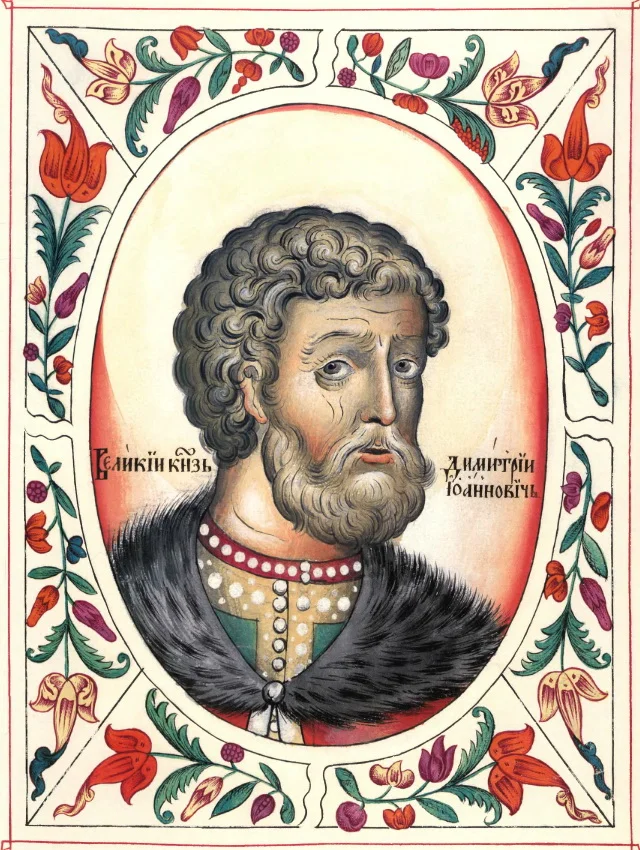
Dmitry Donskoy
Dmitry Ivanovich, later known as Dmitry Donskoy, strengthened Moscow’s position among the principalities of northeastern Rus’. His victory over Mamai’s forces at Kulikovo in 1380 became one of the most celebrated events in Russian history, but it did not end the region’s dependence on the Golden Horde. Two years later, Khan Tokhtamysh sacked Moscow and restored tribute payments. Dmitry’s legacy is therefore both a story of expanding Muscovite power and a reminder of the limits under which he ruled.
A prince in a divided realm
Dmitry was born in Moscow on 12 October 1350, the son of Ivan II. He became prince of Moscow as a child after his father’s death in 1359. At the time, the princes of northeastern Rus’ competed for the title of grand prince of Vladimir, which depended on recognition by the khans of the Golden Horde.
Dmitry secured that title through shifting alliances with rival khans and their powerful commanders. His authority was contested by other princes, especially Mikhail of Tver. In 1375, after a prolonged conflict, Dmitry forced Mikhail to recognize his seniority. Moscow’s influence grew, though the larger political order still required the Russian princes to seek the khan’s approval and pay tribute.
Dmitry also strengthened Moscow’s physical defenses. In 1367, he ordered the construction of a white-stone Kremlin, replacing the older wooden fortifications. The new walls made the city more secure and visibly marked its growing importance.
Kulikovo and the Golden Horde
In the late 1370s, Dmitry’s relationship with Mamai, a powerful ruler within the Golden Horde, deteriorated. Moscow had withheld some payments and rejected Mamai’s efforts to dictate the succession in Vladimir. Mamai gathered an army to reassert his authority.
On 8 September 1380, Dmitry led an alliance of Rus’ princes and troops against Mamai’s forces at Kulikovo Field, near the Don River. The Rus’ army won a major victory, and Dmitry’s later epithet, “Donskoy,” commemorated the battle. The victory raised Moscow’s prestige and showed that a united force could defeat a powerful Horde army.
The result did not bring independence. Mamai was soon defeated by Tokhtamysh, who reunited much of the Horde and demanded recognition from the Russian princes. In 1382, when Dmitry could not raise an army to stop him, Tokhtamysh captured and sacked Moscow. Dmitry later acknowledged the khan’s authority and resumed tribute payments. His son Vasily was sent to Tokhtamysh’s court as a hostage.
Moscow’s growing authority
Despite that setback, Dmitry’s reign helped consolidate Moscow’s influence. His authority over neighboring princes and his ability to organize a large military coalition strengthened the principality. Church leaders, including Sergius of Radonezh, supported his policies and served as envoys in important political negotiations.
Dmitry’s succession arrangements also mattered. When he died, he named his son Vasily as heir to his territories and the grand principality of Vladimir. This asserted the idea that the title could pass within the Moscow dynasty rather than being granted anew by the khan, though in practice the Horde’s approval and tribute obligations remained significant.
Legacy
Dmitry died in Moscow on 19 May 1389. Later generations remembered him as a champion of Rus’ against Mongol rule, and the victory at Kulikovo became a powerful symbol of unity and resistance. The historical picture is more complex: he defeated Mamai, but not the Golden Horde as a whole, and Tokhtamysh’s invasion soon reasserted its power.
His lasting achievement was to raise Moscow’s standing and help make it the leading principality in northeastern Rus’. The white-stone Kremlin, the coalition at Kulikovo, and the hereditary transfer of power to Vasily all contributed to that rise. The image of Dmitry as a national hero grew over centuries, but it began with a ruler who combined military strength, dynastic strategy, and careful navigation of a shifting political world.