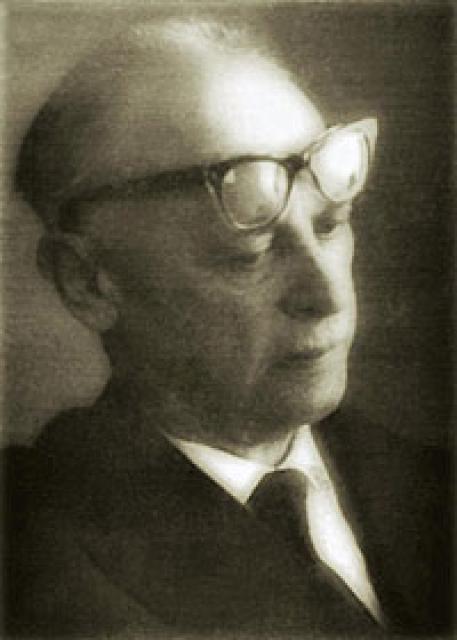
Dmitry Klenovsky
 Germany
- The Last Tsarskoye Selo Poet
- A Classicist in a Modern World
- The Daughter of Tsarskoye Selo
- Education in a Crumbling Empire
- The Silent Years
- Poetry's Resurgence in Exile
- A Journey in Verse
- A Pessimist in Exile
- The Poetic Divide
- A Polemic of Publication
- A Friend's Exhortation
- Contradictions and Unseen Hope
- "No, don't think that I am crying,
The Last Tsarskoye Selo Poet
Nina Berberova, a renowned poet, characterized Dmitry Klebanovsky as the "last Tsarskoye Selo poet." Tsarskoye Selo, however, was known for its Renaissance-like atmosphere, characterized by joy and frivolity. Klebanovsky, on the other hand, emerged as a somber figure within this context.
A Classicist in a Modern World
As a poet, Klebanovsky remained a staunch classicist. His role was to remind people of the existence of classical traditions, fostering good manners and preserving the elegance of poetic form. He believed that embracing classicism did not preclude a poet from being thoroughly modern.
The Daughter of Tsarskoye Selo
Anna Akhmatova, a contemporary of Klebanovsky, did not oppose the metaphorical complexities and rhythmic freedom of poets like Marina Tsvetaeva, Boris Pasternak, and Osip Mandelstam. Instead, she offered a serene counterpoint, showcasing the naturalness of breath and the dignity of poetic structure. Her classicism, nurtured in the cradle of Tsarskoye Selo, made her the true disciple of not its gymnasium director but of the poet Innokenty Annensky.
Education in a Crumbling Empire
Young Klebanovsky, the son of academic painter Iosif Kraчковsky, entered Tsarskoye Selo Gymnasium during its decline. The school was marred by unruly students and apathetic teachers, reflecting the wider decay of a crumbling empire. War and anti-imperial plots ultimately led to revolution, overturning classical traditions and branding them as dubious or even anti-народ phenomena.
The Silent Years
Klebanovsky's first poetic collection, "Palitra" (Palette), was published on the eve of the revolution, but it found no audience amidst the chaos of civil strife. He studied law at St. Petersburg University and briefly served in the army. After the revolution, he wandered for two years in Moscow before relocating to Kharkiv with his mother. There, he translated Ukrainian poets, including Maksym Rylsky, and worked for the Ukrainian Radiotelegraph Agency. His own poetic output ceased in the mid-1920s, as he felt a spiritual vacuum in the atmosphere, suffocating his creative impulses.
Poetry's Resurgence in Exile
During the German occupation, Klebanovsky migrated to Austria with his wife, a Soviet German. Fleeing the advancing Red Army, they settled in the German town of Traunstein. It was there that his poetry returned: "As soon as my foot left Soviet soil, I unexpectedly resumed my literary work... without setting myself this task." His experiences in Tsarskoye Selo permeated the pages he penned in Traunstein.
A Journey in Verse
Recovering his poetic voice proved challenging. Lines faltered, rhymes clashed, and rhythms veered between monotony and stumbling. His poetry was published in meager print runs, leaving him uncertain if anyone was reading it. A glimmer of hope came from Ivan Bunin, who sent him a collection of stories inscribed: "To a dear brother..."
A Pessimist in Exile
Archbishop John of San Francisco (Prince Dmitry Shakhovskoy) wrote to Klebanovsky after hearing him recite his poem "Light burns within me and above me" on "Voice of America." Their correspondence began, with the archbishop adopting the pen name "Sputnik" at Klebanovsky's suggestion.
Despite his pessimism about modern Russian literature and Russia's future, Sputnik encouraged Klebanovsky, sharing verses by Leonid Martynov and Yevgeny Vinokurov. Klebanovsky responded with reservations, dismissing these works as "Soviet poetry," unsuitable for translation.
The Poetic Divide
Sputnik persisted, arguing that even in the depths of ideological distortion, Russian literature was returning to humanity through the work of poets. Klebanovsky remained unyielding, accusing the Kamkin publishing house of promoting Soviet literature in the West. He ignored the brilliance of Martynov's "Lukomorye" and Vinokurov's "Hamlet" and "Earrings on Malaya Bronnaya."
A Polemic of Publication
Klebanovsky complained to Sputnik about the excessive praise given to Soviet poets in Western publications while emigrant poets were neglected. However, when Kamkin announced plans to publish an anthology of over forty emigrant poets, Klebanovsky protested, claiming that there were not enough poets worthy of inclusion and that it would result in talented voices being overshadowed by mediocre ones.
A Friend's Exhortation
Sputnik responded with a mixture of exhortation and exasperation: "You would commit a considerable poetic and ethical sin if you did not send your verses to the Collection of Foreign Poets published by T.P. Fesenko - Kamkin. I believe you belong there too..."
Contradictions and Unseen Hope
Despite his unwavering pessimism about Russia's future, Klebanovsky's own words contradicted his outlook: "Our world is in delusion. It whispers incantations, It stifles everything that life still has the right to. But there is no ruined building in the world where grass has not sprouted."
Even as buildings crumbled, grass would grow, but Klebanovsky failed to see it. This was his misfortune. He was fortunate, however, to have a friend like Sputnik, who bestowed upon him the title of "the first poet of the Russian emigration." It is better to overestimate poets than to underestimate them, but numbering in art is ultimately futile.
Klebanovsky's poetic stance reflected an inherent arrogance, inherited from Gumilyov's gymnasium days. He rarely praised other poets, not even his own work:
"No, don't think that I am crying,
I am simply waning with the daysOne truth richer,
One joy poorer."
These words served as his partial, if not complete, vindication.