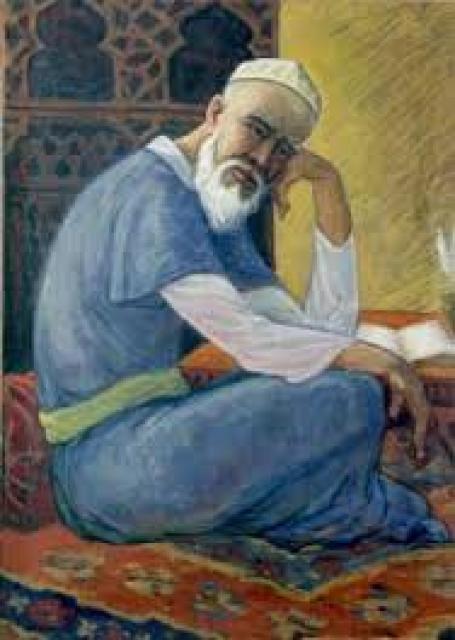
Yusuf Balasaguni
 Kazakhstan
Biography of Yusuf Balasaguni
Yusuf Balasaguni was a renowned Turkic poet and philosopher of the Middle Ages. Born in the city of Balasagun, also known as Kuz-Ordu, Yusuf's life and work can be primarily understood through excerpts from his poem "Kutadgu Bilig" and two prefaces to his composition, one in prose and the other in verse.
According to available information, Yusuf was born in Balasagun, a city located in the Semirechye region, in the Chui Valley, near the modern city of Tokmok. Balasagun was one of the largest cities and a major trade and craft center of the Karakhanid state, which was an ethnic union of various Turkic tribes. The social and economic foundation of the khanate was a unique combination of nomadic and settled agriculture.
Yusuf Balasaguni hailed from a specific cultural and political region that encompassed areas such as Otrar (Farab), Shash (Tashkent), Taraz, the Chui Valley, the Issyk-Kul region, Fergana, and Kashgar. Linguistically, he is considered an ancestor of Turkic-speaking peoples, with close ties to the Kazakhs and Kyrgyz, specifically the Turkic Chigils. Yusuf received his education in renowned cultural centers of the time, such as Farab, Kashgar, and Bukhara. Proficient in Arabic and Persian, he delved into philosophical and scientific writings across various fields of knowledge. The intellectuals of that era had diverse interests, engaging in philosophy, science, poetry, politics, and chess. Being well-rounded and enriched with life experiences, Yusuf arrived in Kashgar and spent eighteen months diligently working on his great poetic work. According to Turkish philosopher R.R. Arat, Yusuf was around 54 years old when he completed the poem. If this is true, Yusuf Balasaguni was born in 1015-1016. Another researcher of Turkic poetry, A. Dilachar, suggests his birth year to be 1018. He dedicated his famous work to Tabgach-Bogra-Kara-Hakan-Ali Hasan from the Karakhanid dynasty, earning him the title "Hass-Hajib," which translates to "court minister" or "chief chamberlain."
The poem "Kutadgu Bilig" became known to the Western world through the Austrian orientalist Hammer-Purgstall, who acquired the manuscript in Istanbul in 1796 and gifted it to the Vienna Library. The first edition in German was published by the renowned orientalist G. Vambery. The complete text of the poem was introduced into scholarly discourse by V.V. Radlov in 1891-1900, along with a translation into German. S.E. Malov made the first Russian translation of excerpts from the poem. N. Grebnev translated it freely as "The Science of Being Happy" in 1971, while K. Kerimov translated "Kutadgu Bilig" into Uzbek in 1896. R. Arat conducted extensive research, critically analyzing the texts of all three manuscripts (Vienna, Cairo, and Namangan), and presented a scientifically accurate compilation of the poem in 1947. S.N. Ivanov translated the complete text of "Kutadgu Bilig" into Russian under the title "Blessed Knowledge" (Moscow, 1983). This edition, edited by Academician A.N. Kononov and S.N. Ivanov, includes "Articles and Explanations on Individual Bayts (verses)." In 1970, the Fourth Turkological Conference dedicated to "Kutadgu Bilig" took place in Leningrad, emphasizing the need to expand and deepen the study of this literary monument. In 1986, A. Egeubaev presented Yusuf's work in Kazakh.
One of the first attempts to examine Balasaguni's work in the context of a vast cultural region initially associated with the formation of the caliphate was made by the German scholar Otto Alberts. He proposed the concept of a continuous connection between the teachings of Ibn Sina, particularly his ethics, and the similar views of Yusuf Balasaguni. Furthermore, Alberts attempted to compare the ethical views of Aristotle and Yusuf. The study of Balasaguni's work and the era of its creation were further developed by prominent Russian orientalists V.V. Bartold and S.E. Malov, as well as renowned Soviet historians and literary scholars E.E. Bertels, A.N. Samoilovich, A.N. Kononov, and others.
Contemporary scholarship has a certain volume of research on Balasaguni's work. However, it should be noted that scientific interest in the poet's work has mainly focused on historical and philological aspects. Nevertheless, it has been emphasized that "the significance of this monument in linguistic, literary, historical, and cultural-historical terms is immense, and therefore it is imperative to expand the scope and depth of its study." Yusuf Balasaguni's work, "Kutadgu Bilig," represents the first encyclopedic literary work in a non-official literary language, Arabic, of that time. Instead, it was written in the native Turkic language, which signifies his patriotism and love for his mother tongue. However, political motives also guided him, as he aimed to educate the Karakhanid dynasty, which had not yet fully transitioned from a nomadic society to a sedentary one, on how to govern a country with highly developed settled regions such as Mawarannahr and Eastern Turkestan. To ensure his teachings were understood by the nomadic Karakhanids, he needed to write in Turkic. But "Kutadgu Bilig" is not merely a political treatise; it encompasses a vast range of knowledge from various fields and cultures of its time. It synthesizes and provides a philosophical interpretation of the author's own life positions, addressing existential questions of the meaning of life, human destiny, and their place and role in the social and natural universe. Balasaguni's work presents a comprehensive system that examines both general philosophical problems and practical, ethnic, and aesthetic issues. The pursuit of encyclopedism, universality, and the comprehensive exploration of philosophical issues was inherent to the cultural region to which Yusuf belonged. His worldview has three roots: philosophical, shamanistic, and Islamic.
Yusuf is part of a broader Renaissance movement in the East, and his work clearly bears the imprint of Eastern Peripatetic philosophy. This refers to a powerful cultural and philosophical tradition that traces its origins to Aristotle and continues with al-Farabi and Ibn Sina. The influence of this tradition on the author of "Kutadgu Bilig" was first noted by German orientalist O. Alberts. The intellectual paradigm of the Eastern Middle Ages is not limited to the professional work of philosophers alone. It is also represented by the "non-professional" philosophical creativity of poets like Rudaki, Ferdowsi, Yusuf Balasaguni, Omar Khayyam, Nizami, Navoi, and Nasimi. However, the existence of poetry during this time exhibits distinct characteristics. On one hand, the creative thinking of these poets is predominantly rationalistic, while on the other hand, this rationalism is veiled in symbolic Sufi coverings. The complexity of poetic forms, imagery, and techniques does not alter the fundamental essence of poetry aimed at addressing real-life situations and the pursuit of humanistic principles of truth, goodness, and happiness. In essence, medieval poetry delved into the most universal philosophical, moral, and social problems, much like philosophy itself. Many poetic works can be classified as philosophical works and, therefore, should be included in the process of historical and philosophical development.
Literature and poetry, along with philosophy, served specific worldview and value functions. Expressing philosophy through poetry was an ancient and enduring tradition of ideological development. The greatest poets of the Eastern Middle Ages can confidently be considered representatives of philosophical thought rather than mere literary figures.
The second layer that shapes Yusuf Balasaguni's worldview consists of various pre-Islamic beliefs such as Zoroastrianism, Manichaeism, Buddhism, and Christianity, which were prevalent among both nomadic and settled peoples before the advent of Islam. Among these beliefs, indigenous pagan and shamanistic beliefs emerge strongly within the context of "Kutadgu Bilig."
A.N. Kononov and S.N. Ivanov consider the "Muslim element" to be dominant in the philosophical foundations of the poem, stating, "The poem 'Blessed Knowledge' by Yusuf Balasaguni is the first, oldest, and only work written in one of the Turkic languages based on Muslim ideology and promoting this ideology." However, Yusuf is not just an ideologue or politician; he is a wordsmith. Therefore, philosophy, paganism, and Islam must have influenced "Kutadgu Bilig" beyond poetic traditions, primarily the Turkic poetic tradition (oral and written) and the Tajik-Persian tradition (specifically Rudaki and Ferdowsi).
A comprehensive philosophical interpretation of Balasaguni's poetry will contribute to the understanding and exploration of the poet-philosopher's complex inner world, unveiling its profound layers and addressing the interests and attention of a broad audience. Including "Kutadgu Bilig" in the field of historical and cultural analysis will further the development of the history of social thought and the artistic traditions of Turkic peoples during the medieval period.
The significance and relevance of introducing Yusuf Balasaguni's "Kutadgu Bilig" into scholarly discourse clearly emerge in terms of the comprehensive study of the multidimensional process of cultural development. The scientific utilization, study, and interpretation of Balasaguni's work from a historical and philosophical perspective enrich our understanding of the intellectual content and cultural life and connections of Eastern peoples during the medieval period.



