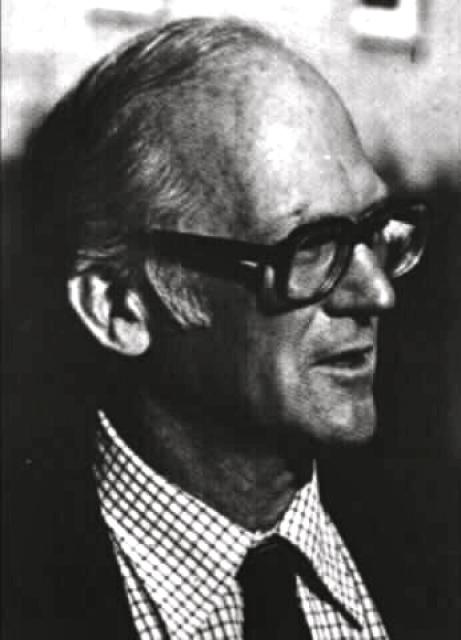
Donald Davidson
 USA
USABiography of Donald Davidson
Donald Davidson was an American philosopher who made significant contributions to the fields of philosophy of mind, philosophy of language, and epistemology. He taught at Stanford University, Princeton University, the University of Chicago, and the Rockefeller University. In 1981, he became a professor at the University of California, Berkeley.
Early Life and Education
Donald Davidson was born on March 6, 1917 in Springfield, Massachusetts. He completed his undergraduate studies at Harvard University.
Contributions to Philosophy
Throughout his career, Davidson developed theories on action, knowledge, consciousness, and the nature of language. One of his major works, "Mental Events" (1970), explores how mental and physical events can be causally related without there being strict psychophysical laws connecting them. This position, known as "anomalous monism," asserts that mental events are identical to physical events, but there are no psychophysical laws that govern their relationship.
Davidson also proposed a compositional theory of natural language, which emphasizes the infinite potential for sentence formation. He drew on Alfred Tarski's recursive theory of truth to provide an adequate account of the nature of language. Additionally, Davidson's work on radical interpretation, as demonstrated in "Radical Interpretation" (1973), offers methods for interpreting unknown languages, emphasizing the importance of charitable interpretation and logical coherence in understanding a speaker's beliefs.
Selected Works
Some of Davidson's notable works are included in collections such as "Inquiries into Truth and Interpretation" (1981) and "Essays on Actions and Events" (1982). These writings explore various aspects of truth, interpretation, and the philosophy of action.
Donald Davidson's contributions have had a significant impact on contemporary philosophy, particularly in the realms of philosophy of mind, language, and epistemology. His theories continue to be influential in shaping the discourse in these areas of study.