Douglas Osheroff
- Childhood and Education
- The Helium-3 Discovery
- Research, Teaching, and Public Service
- Personal Life and Legacy
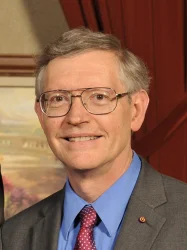
Douglas Osheroff is an experimental physicist whose curiosity about matter at temperatures close to absolute zero led to one of the landmark discoveries in modern low-temperature physics. As a Cornell graduate student, he helped show that helium-3 can become a superfluid, a state in which a liquid flows without ordinary viscosity. The breakthrough later earned him a share of the 1996 Nobel Prize in Physics.
Childhood and Education
Born in Aberdeen, Washington, on August 1, 1945, Osheroff grew up in a family with deep ties to medicine. His father was a physician, but Osheroff was drawn instead to experiments, gadgets, and the natural world. As a boy and teenager, he built mechanical, electrical, and chemical projects, sometimes taking risks in the process. He later recalled constructing an X-ray machine during high school.
Osheroff chose physics and enrolled at the California Institute of Technology, where he earned a bachelor’s degree in 1967. The lectures of Richard Feynman helped make Caltech an especially vivid intellectual environment. He continued at Cornell University, earning a master’s degree in 1969 and a doctorate in 1973. At Cornell he joined the low-temperature physics group led by David Lee and Robert Richardson, and met Phyllis Liu, whom he later married.
The Helium-3 Discovery
The Cornell team was investigating helium-3, a rare isotope that behaves differently from the more familiar helium-4. Researchers were interested in how helium-3 behaved at extraordinarily low temperatures, only a few thousandths of a degree above absolute zero. Osheroff worked with a specialized cell that allowed the group to cool and monitor the sample.
In November 1971, Osheroff noticed small but repeatable changes in the data, including unexpected pressure shifts as the sample cooled. Those clues signaled that the material was changing state. Further experiments established that liquid helium-3 becomes superfluid at these extreme temperatures. The discovery revealed more than one superfluid phase and opened a new field of research into quantum fluids and the behavior of matter at its limits.
The result was especially striking because helium-3 atoms obey the quantum rules associated with fermions, unlike helium-4. Their superfluid behavior required a new explanation involving the formation of pairs of atoms. The findings, developed and published with Lee and Richardson, reshaped physicists’ understanding of superfluidity and its links to other quantum phenomena.
Research, Teaching, and Public Service
After completing his doctorate, Osheroff joined Bell Laboratories, where he spent about fifteen years studying quantum fluids, solids, and materials at very low temperatures. In 1987 he moved to Stanford University, joining its physics and applied physics faculty. He served as chair of Stanford’s Physics Department from 1993 to 1996 and became known as a committed teacher as well as a researcher. The university honored him with its Gores Award for Excellence in Teaching in 1991.
In 1996, Osheroff shared the Nobel Prize in Physics with Lee and Richardson for the discovery of superfluidity in helium-3. He had previously received a MacArthur Fellowship in 1981, among other honors. In 2003, he also served on the independent Columbia Accident Investigation Board, which examined the loss of the space shuttle Columbia and its crew.
Personal Life and Legacy
Osheroff has spoken about photography and gardening as interests he inherited from his father. His wife, Phyllis Liu Osheroff, is a biochemist. Stanford lists him as professor emeritus of physics, reflecting a career that combined experimental research, university teaching, and service beyond the laboratory.
The helium-3 work remains his signature achievement, but its importance extends well beyond a single result. By revealing superfluid phases in a rare isotope, Osheroff and his collaborators gave scientists a powerful new system for exploring quantum matter and the surprising behavior that emerges when ordinary temperatures and intuitions fall away.