Martin Rees
- From Shropshire to Cambridge
- Exploring the universe’s extremes
- A scholar and public figure
- Books and the human place in the cosmos
- Legacy
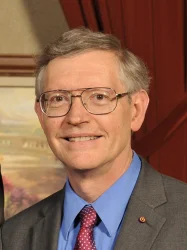
Martin Rees has spent a career studying some of the universe’s most extreme phenomena, from black holes and quasars to the first stars and galaxies. A theoretical astrophysicist and cosmologist, he has also been one of Britain’s most influential public voices on science. His academic work helped shape modern thinking about how galaxies form and how energetic objects behave, while his books and lectures have brought big questions about the cosmos to readers beyond the scientific community.
From Shropshire to Cambridge
Martin John Rees was born on June 23, 1942, in York, England. His parents were teachers, and he grew up in rural Shropshire, where they founded a school. He attended Shrewsbury School before entering Trinity College, Cambridge, to study mathematics. The choice placed him close to a rapidly changing field: in the 1960s, discoveries such as quasars and pulsars were opening new questions about gravity, stars, and the structure of the universe.
At Cambridge, Rees pursued postgraduate research under the astrophysicist Dennis Sciama, whose students became central figures in the development of modern cosmology. He completed his doctorate in 1967. After research positions in Britain and the United States, Rees joined the University of Sussex and then returned to Cambridge, where he became Plumian Professor of Astronomy in 1973. He later directed the university’s Institute of Astronomy and became a Royal Society Research Professor.
Exploring the universe’s extremes
Rees’s research ranged across astrophysics, but a central theme was how matter behaves under extreme gravity and energy. He helped develop the view that supermassive black holes power quasars and other active galactic nuclei, brilliant objects at the centers of galaxies. By studying the changing light and radio emissions from these sources, he and other researchers investigated the processes unfolding close to black holes.
He also made influential contributions to theories of galaxy formation, the cosmic microwave background, and gamma-ray bursts. His work explored how the first generations of stars and galaxies emerged after the universe’s early dark ages, and how black holes and energetic stellar events shaped the cosmos. Rees received the 2024 Wolf Prize in Physics in recognition of his contributions across theoretical astrophysics and cosmology.
A scholar and public figure
Alongside research, Rees took on major roles in British science. He became Astronomer Royal in 1995, a historic title associated with advising the monarch on astronomical matters. He served as Master of Trinity College from 2004 to 2012 and as President of the Royal Society from 2005 to 2010. In 2005 he entered the House of Lords as Lord Rees of Ludlow, sitting as a crossbench peer.
He held the Astronomer Royal title for three decades, retiring in 2025 when Professor Michele Dougherty succeeded him. Rees remains an emeritus professor at Cambridge and a Fellow of Trinity College. His leadership work has included support for international scientific cooperation and public discussion of the opportunities and dangers created by powerful technologies. He also helped establish the Centre for the Study of Existential Risk at Cambridge, which brings researchers from different fields together to study threats that could affect humanity’s long-term future.
Books and the human place in the cosmos
Rees has written for general readers about how the physical universe works and what its laws mean for life. Books such as Just Six Numbers and Our Cosmic Habitat explain how fundamental features of the cosmos relate to the possibility of complexity and life. In works including Our Final Century and On the Future, he has also examined the choices societies face as scientific capabilities advance.
His public writing reflects a consistent interest in scale: the immense age and size of the universe, the small number of physical conditions that shape it, and the responsibilities of a civilization capable of changing its own future. This combination of deep scientific work and public engagement has made him a familiar figure well beyond astronomy.
Legacy
Rees’s career has bridged theoretical research, university leadership, and public service. His work on quasars, black holes, galaxies, and the early universe helped define key questions in modern astrophysics. Through teaching, scientific institutions, and accessible books, he has also encouraged wider audiences to see the universe not as a distant abstraction but as a subject connected to humanity’s origins and future.