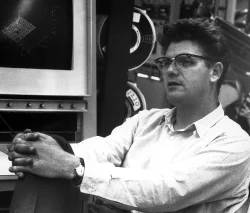
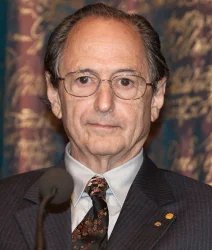
Isamu Akasaki
- Early Life and Education
- A Long Bet on Gallium Nitride
- From Laboratory Breakthrough to Modern Lighting
- Final Years and Legacy
Isamu Akasaki devoted decades to a semiconductor that many researchers considered too difficult to use. His work on gallium nitride helped solve the problems that had blocked an efficient blue light-emitting diode: producing high-quality crystals and controlling their electrical properties. The blue LED made bright, energy-saving white lighting possible and opened the door to new display and lighting technologies. For this achievement, Akasaki shared the 2014 Nobel Prize in Physics with Hiroshi Amano and Shuji Nakamura.
Early Life and Education
Akasaki was born on January 30, 1929, in Chiran, Kagoshima Prefecture, Japan. He studied chemistry at Kyoto University, graduating in 1952. He then began research in industry before continuing his academic work at Nagoya University, where he earned a doctorate in engineering in 1964. His early research involved compound semiconductors, materials made by combining elements from different groups of the periodic table.
In the 1960s and early 1970s, light-emitting diodes were already used to produce red and green light, but a practical blue device remained an elusive goal. Blue light requires a semiconductor with a wider energy gap than the materials used in existing LEDs. Gallium nitride, or GaN, appeared promising, but scientists struggled to grow high-quality crystals and to make the p-type material needed for an efficient junction.
A Long Bet on Gallium Nitride
In 1973, Akasaki began pursuing nitride semiconductors for high-performance blue light emitters. The choice was considered risky because other researchers had encountered persistent problems with GaN. Akasaki continued the work first in industry and later at Nagoya Institute of Technology, where he was appointed in 1981. He built a research group and worked closely with students, including Hiroshi Amano.
A major breakthrough came in 1985, when Akasaki and Amano grew a smooth, high-quality GaN crystal on sapphire using a low-temperature buffer layer. This method overcame a key obstacle: growing GaN directly on sapphire had produced poor crystal quality. The achievement gave researchers a reliable foundation for further experiments.
The team then made progress in controlling GaN’s conductivity. In 1989, Akasaki and Amano demonstrated p-type GaN after doping the material with magnesium and activating it using low-energy electron-beam irradiation. Together with n-type GaN, this made it possible to create a p-n junction, the essential structure of an LED. They reported a GaN-based blue and ultraviolet light-emitting diode, an important step toward a useful device.
From Laboratory Breakthrough to Modern Lighting
Akasaki and Amano’s work was part of a larger international effort. Shuji Nakamura, working independently at Nichia Corporation, developed other ways to produce bright blue LEDs, including a method using thermal annealing to activate magnesium-doped GaN and later materials based on indium gallium nitride. The advances by all three researchers helped transform blue LEDs from laboratory demonstrations into efficient, practical light sources.
Blue light was crucial because it could be combined with red and green LEDs or used to excite a phosphor coating to create white light. Efficient white LEDs consume less electricity and last longer than many conventional bulbs. They also enabled new forms of backlighting and compact displays. The Nobel committee recognized the invention of efficient blue LEDs as a technology with broad effects on everyday life.
Akasaki continued his academic career at Nagoya University and Meijo University. He was known for his persistence and for maintaining a research program in a field many had abandoned. Japan honored him as a Person of Cultural Merit in 2004 and awarded him the Order of Culture in 2011. In 2014, he received the Nobel Prize in Physics with Amano and Nakamura.
Final Years and Legacy
Akasaki died of pneumonia in Nagoya on April 1, 2021, at age 92. His research showed how patient work on a seemingly intractable materials problem could lead to a technology used around the world. The blue LED is now part of household lighting, phones, televisions, traffic signals, and many other devices.
His legacy lies both in a practical invention and in the example of a scientist who chose a difficult path and stayed with it for decades. By finding ways to grow and control gallium nitride, Akasaki helped create an efficient light source that changed how people illuminate homes, streets, and screens.