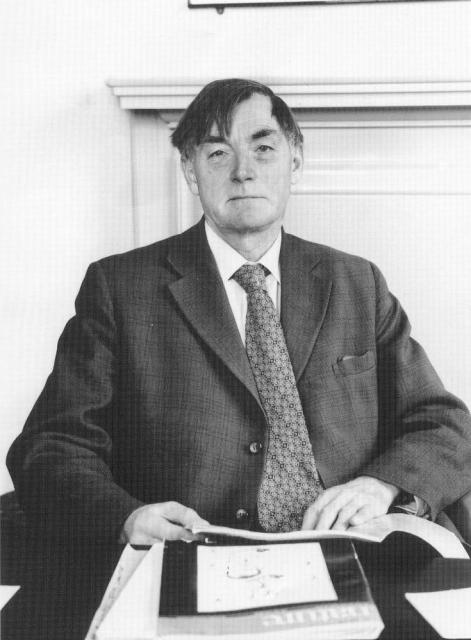
Duglas Falkoner
 Great Britain
Early Life and Education
Douglas Scott Falconer was born in 1913 in the small Scottish town of Oldmeldrum, to a family of a priest from Edinburgh. Shortly after his birth, the family returned to Edinburgh. During his school years, Douglas became interested in science and was accepted into university after completing school. However, a severe case of tuberculosis delayed the start of his studies for five years. During his recovery, Douglas read numerous works, including Morgan's "The Theory of the Gene." D'Arcy Thompson, under whom Falconer studied zoology, suggested waiving the exams for such a promising student, but rules prevailed, and Douglas passed the exam, receiving a first-class honors degree.
Career
After starting work in a group of geneticists under the guidance of Professor Conrad Waddington, Douglas Falconer became a leading authority in quantitative genetics. Having worked in Edinburgh his entire life, Falconer made a significant contribution to science. His book "Introduction to Quantitative Genetics" went through four editions from 1960 to 1996 and became a reference book for many scientists. Falconer's early work focused on genetic analysis of Mendelian mutations in mice. He was the first to discover a sex-linked mouse mutation while still a student.
Personal Life
While still a student, Douglas married Margaret Duke, who studied classical subjects. Margaret and their two sons survived Douglas. The family shared a common interest in music, and Douglas enjoyed playing the flute. In his middle age, Douglas developed diabetes, and by the 1960s, his health was fragile. However, he continued to pursue science, visiting his workplace and publishing for many years after retiring in 1980, staying engaged in research developments and participating in discussions.
Education and Career
- Early education – Edinburgh Academy
- University of St. Andrews (1940)
- 1940-1943: University of Cambridge
- 1943-1945: Lecturer at Queen Mary College, London
- 1945-1947: Assistant to R.A. Fisher in the Department of Genetics at Cambridge; began working with mice.
- From 1947: Worked in Edinburgh in the Genetics Section of the Agricultural Research Council (ARC) at the Animal Breeding and Genetics Research Organization (ABGRO). Falconer worked in Edinburgh for the rest of his career. In 1957, the Genetics Section was renamed the Animal Genetics Department of the ARC.
- In 1968, Falconer became head of the Department and held a position at the University of Edinburgh.
- From 1969 to 1977, Falconer led the Genetics Department at the university.
- In 1980, Falconer retired, and the ARC Department was closed. Douglas Scott remained an active Professor Emeritus until the late 1990s.
Honors and Distinctions
For his contributions to quantitative genetics, Douglas Scott Falconer received several prestigious titles:
- 1969: Doctor of Science, University of Cambridge
- 1972: Fellow of the Royal Society of Edinburgh
- 1973: Fellow of the Royal Society of London.