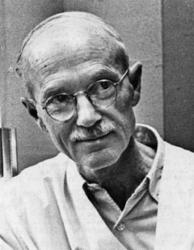
Iosif Rappoport
- Early Life and Education
- Military Service and Valor
- Groundbreaking Discoveries in Chemical Mutagenesis
- The Lysenko Affair and Its Impact on Genetics
- Excommunication and Forced Redeployment
- Return to Genetics and Scientific Legacy
Early Life and Education
Iosef Rapoport was born into a family of a physician in Chernihiv, Ukraine. In 1930, he enrolled in the biology faculty of Leningrad State University, where he pursued his studies in genetics. He then completed his graduate degree at the genetic laboratory of the Institute of Experimental Biology of the USSR Academy of Sciences, led by the renowned biologist Nikolai Konstantinovich Koltsov. Rapoport earned his Candidate of Biological Sciences degree in 1938.
Military Service and Valor
During the Great Patriotic War, Rapoport fought bravely, rising through the ranks from platoon commander to chief of staff of the 184th Guards Regiment of the 62nd Guards Rifle Division. He sustained two serious wounds, losing the use of his left eye. Rapoport's courage and ingenuity in battle, such as his success in repelling German tanks in Hungary using captured "Faust cartridges," earned him two Orders of the Red Banner, the Order of Suvorov III, the American Legion of Merit, and a nomination for the title of Hero of the Soviet Union.
Groundbreaking Discoveries in Chemical Mutagenesis
After the war, Rapoport resumed his scientific research in genetics at the Institute of Cytology, Histology, and Embryology of the USSR Academy of Sciences. His seminal achievement was the discovery of chemical substances with potent mutagenic properties (mutagens and supermutagens). Experiments using Drosophila mutants confirmed his insights, leading to the establishment of a new field in genetics known as Chemical Mutagenesis.
The Lysenko Affair and Its Impact on Genetics
However, genetics in the USSR faced a major setback in 1948 with the rise of the anti-scientific campaign orchestrated by figures like Trofim Denisovich Lysenko and supported by Joseph Stalin. Rapoport, a staunch advocate for genetics, courageously opposed "Lysenkoism" at the infamous "August Session of VASKhNIL." In 1949, he was expelled from the Communist Party for defying the decisions of the session.
Excommunication and Forced Redeployment
The suppression of genetics and the subsequent persecution of its supporters had far-reaching consequences for Rapoport. From 1949 to 1957, he was forced to work in expeditions of the Ministry of Oil and Geology, focusing on paleontology and stratigraphy.
Return to Genetics and Scientific Legacy
In 1957, Rapoport returned to genetic research, joining a team of scientists at the Institute of Chemical Physics of the USSR Academy of Sciences. Together, they explored chemical mutagens, compared their effects to radiation mutagens, and conducted experiments in phenogenetics.
In 1965, at the behest of Academician N.N. Semenov, the Institute of Chemical Physics established a Department of Chemical Genetics with four laboratories. This allowed for expanded research in theoretical and experimental genetics, with a focus on studying inherited and non-inherited variability. The findings were subsequently applied to agricultural selection, industrial microbiology, and other fields.
In recognition of his exceptional contributions, Rapoport was awarded the Order of the Red Banner of Labor in the 1970s, elected as a Corresponding Member of the USSR Academy of Sciences in 1979, and bestowed with the prestigious Lenin Prize in 1984.