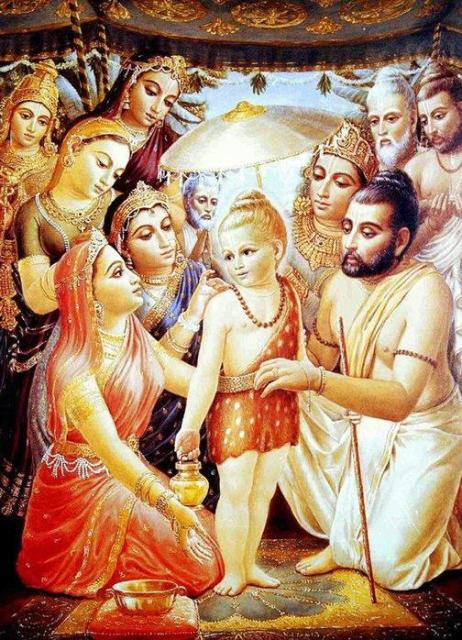
Dzhiva Gosvami
 India
IndiaBiography of Jiva Goswami
Jiva Goswami was one of the most prominent theologians of the Gaudiya Vaishnava tradition of Hinduism. He was a prolific writer and author of numerous philosophical works on theology, bhakti-yoga practice, and related disciplines. Jiva Goswami was one of the Six Goswamis of Vrindavan, the nephew of the leading members of this group – Rupa Goswami and Sanatana Goswami. Followers of Gaudiya Vaishnavism consider Jiva Goswami to be an incarnation of Vilasa-manjari, an eternal gopi-servant of Krishna in the spiritual realm.
Early Years and Spiritual Journey
Very little is known about Jiva Goswami's childhood. He was born in Ramkeli in the district of Maldah, West Bengal, as the son of Shrivallabha Mallika (also known as Anupama). His father was the younger brother of Rupa and Sanatana, and his mother's name is unknown. From a very young age, Jiva showed a inclination towards worshipping Krishna and extraordinary intellect, completing the study of Sanskrit grammar and poetry in a short period of time.
When Jiva was three or four years old, Rupa and Sanatana retired from their ministerial positions at the court of Alauddin Hussain Shah (ruled from 1493 to 1519). They were inspired to take this step after meeting Chaitanya Mahaprabhu (1486-1534) and decided to join him as wandering mendicants. Jiva's father, Anupama, also met Chaitanya around the same time and followed in the footsteps of his elder brothers, accompanying Rupa to Vrindavan. Learning that his father and uncles had made the decision to dedicate their lives to serving Chaitanya Mahaprabhu and his mission, young Jiva also decided to join them. According to the biographical work "Bhakti-ratnakara" by Narahari Chakravarti, Chaitanya appeared to Jiva in a dream, which prompted him to leave home and join Rupa and Sanatana. It is not clear from Jiva's biographies whether he ever met Chaitanya in person.
Spiritual Journey and Contributions
Jiva arrived in Navadvipa, West Bengal, where he met one of Chaitanya's closest associates, Nityananda Prabhu. Nityananda took Jiva on a tour of all the holy places in Navadvipa, laying the foundation for the Gaudiya Vaishnava tradition of Navadvipa Parikrama (an annual pilgrimage to the nine islands of Navadvipa). After the parikrama, Nityananda blessed the young Jiva to go to Vrindavan. Jiva first went to Varanasi, where he spent some time studying under Madhusudana Vidya-vachaspati, a disciple of the famous logician and Vedantist Sarvabhauma Bhattacharya. Under Vidya-vachaspati's guidance, Jiva studied all six systems of Hindu philosophy known as Shad-darshana.
In 1535, Jiva arrived in Vrindavan, where he joined Rupa and Sanatana. Around this time, Jiva's father Anupama passed away. In Vrindavan, Jiva received spiritual initiation from Rupa Goswami, who taught him the principles of devotional service to Krishna. Jiva assisted in the composition of Rupa and Sanatana's literary works and their efforts to preach Gaudiya Vaishnavism and excavate forgotten holy places in Vrindavan. After the deaths of Rupa and Sanatana, Jiva Goswami became the highest authority in the Gaudiya Vaishnava sampradaya. In 1542, he established one of the most important temples in Vrindavan, the Radha-Damodara Mandir, installing in it the Deities of Radha and Krishna personally carved by Rupa Goswami. At the same time, Jiva Goswami founded the World Vaishnava Association (Vishva Vaishnava Raja Sabha) and the Rupanuga Vidya Pitha, an educational institution for the study of the works of Rupa and Sanatana. The fame of Jiva Goswami's erudition and spirituality reached Emperor Akbar the Great, who became his devotee and provided him with paper for writing books.
In 1558, Jiva instructed his disciples Narottama, Shrinivas, and Shyamananda to go to Bengal and preach Gaudiya Vaishnava philosophy, taking with them the original manuscripts of Rupa and Sanatana. In his commentaries on the Shat-sandarbhas, called Sarva-samvadini, Jiva Goswami first presented the philosophy of Achintya-bheda-abheda of Chaitanya Mahaprabhu. In essence, the philosophy of Achintya-bheda-abheda, or "inconceivable unity and difference," avoids the extremes of Shankara's monistic Advaita and Madhva's pure dualism, considering the material and spiritual energies of the Supreme Personality of Godhead as simultaneously identical with and distinct from Him.
Jiva Goswami passed away in 1596. His samadhi (tomb) is located on the premises of the Radha-Damodara temple in Vrindavan.


