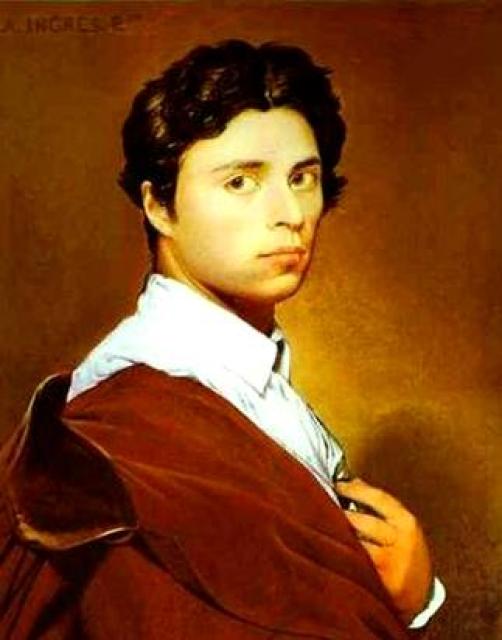
ean Auguste Dominique Ingres
 France
Biography of Jean Auguste Dominique Ingres
Jean Auguste Dominique Ingres, a French neoclassical artist, was born on August 29, 1780, in Montauban. He enrolled in the Toulouse Academy in 1791, where he studied under G.J. Roques and Vigan and collaborated with J. Brian. In addition to his art studies, Ingres pursued a musical career and played the violin in the orchestra of the Toulouse Opera House.
In 1797, Ingres moved to Paris and joined the workshop of Jacques-Louis David. Two years later, he was accepted into the School of Fine Arts. In 1801, he was awarded the Grand (First) Roman Prize for his painting "The Ambassadors of Agamemnon in the Tent of Achilles." However, he was unable to receive the monetary prize from the French treasury and instead received a studio and modest income.
In the following years, Ingres exhibited his works at the Salon in 1803 and 1805, but they received negative reviews from critics. His sensitive nature and sensitivity to criticism often influenced his actions. In 1806, he moved to Rome, where he eventually established his own studio. During this period, Ingres supported himself by creating numerous pencil portraits (most of which are now housed in the Ingres Museum in Montauban).
In 1808, Ingres completed the paintings "The Valpinçon Bather" (Louvre), "Oedipus and the Sphinx," and in 1811, "Thetis Imploring Zeus" (Montauban Museum). In 1814, he painted "Don Pedro, Duke of Toledo, Kissing the Sword of Henry IV" (full title). In 1819, Ingres exhibited his renowned works "The Grande Odalisque" (1814, Louvre), "Philip V Awarding Marshal Berwick the Golden Chain" (1818, Madrid), and "Roger Freeing Angelica" (1819, Louvre). However, disappointed with the cold reception and harsh criticism, he moved to Florence.
Ingres gained significant success with his painting "The Vow of Louis XIII" at the Salon, which led him to return to Paris. He received the Order of the Legion of Honor from King Charles X and became an academician of the Academy of Fine Arts. In 1825, he opened his own studio. In 1833, Ingres exhibited his portrait of Monsieur Bertin (Louvre) at the Salon. In 1834, his painting "Saint Symphorian Walking to His Execution" went unnoticed, which he considered his masterpiece. Consequently, Ingres moved back to Rome and was appointed director of the French Academy in Rome. However, in 1841, he returned to Paris (his works from this period include "Odalisque and Slave" in Cambridge, Fogg Museum, "Antiochus and Stratonice" in Chantilly, Condé Museum, and "Portrait of the Duke of Orléans," owned by the Orléans family).
During this time, Ingres worked on the murals at Château de Dampierre, commissioned by the Duke of Luynes (1841-1847). Unfortunately, the murals, "The Iron Age" and "The Golden Age," were unfinished due to the death of the artist's wife. In Russia, Ingres was commissioned by Tsar Nicholas I (the heir to the throne, Alexander II) to paint "Madonna with the Host" (Moscow, Pushkin Museum), with Saint Nicholas and Saint Alexander standing beside the Madonna. The painting was considered too Latin in spirit, so an dissatisfied Ingres created a replica with Latin saints (1852, London, private collection). He also created another replica with angels next to the Madonna (1854, Louvre). Ingres was known for creating replicas of his famous paintings, often with slight variations.
In 1853, Ingres completed the ceiling painting "The Triumph of Napoleon I" for the city castle (destroyed in 1871 during the Commune), and in 1855, he exhibited his works at the Universal Exhibition in Paris. In 1862, he was awarded the title of lifetime senator. Jean Auguste Dominique Ingres passed away on January 14, 1867, in Paris.