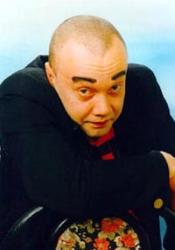
Eduard Akopian
 Armenia
Edward Akopyan - Biography of a Clown
Edward Akopyan is an acclaimed clown and a prize-winner of numerous international circus festivals. In 1988, he participated in the "Circus of the Future" festival in Paris, and in 1993, he won the "Silver Clown" award at the "People, Animals, Sensation!" festival in Berlin. He also achieved the title of laureate at the festival in Verona.
A Clown's Destiny
Many clowns are often sad individuals, hiding their sorrow behind their eyes. It is not easy for them to give themselves up to the ridicule of the crowd every day. As the song by Yuri Kim goes: "Let's turn battlefields into arenas for performances, I will stand in the center and you, like children, laugh, laugh at me..." The clown takes on our dramas, troubles, and sorrows. And if they are a genuine artist, their invisible brush mixes melancholy colors with the bright radiance of humor, awakening our concerns and touching our hearts. Edward Akopyan is such a clown.
A Fateful Trip to the Circus
A group of lively boys spilled out onto the streets of Yerevan from a sports hall. Excited and full of energy from their athletic activities, they stumbled upon a small fortune - 25 rubles near an ice cream stand. They bought ice cream for everyone and still had money left... what to spend it on? A movie? A circus? "Let's go to the circus!" shouted Edik, who had never been there before, unaware that this outing would change his life forever.
They found themselves among the crowd on the gallery, squeezed tightly together, and delighted in the festivities known as the circus. Years later, when Edward Akopyan had become a renowned clown and a prize-winner of many international circus festivals, he would recall this childhood event with the same excitement: "I was with them, the boys, and yet I felt so alone... They were happy, laughing, while I swallowed my tears, not understanding why the sight of the arena, the worn-out carpets, the identical smiles of the artists, and the sequin-adorned faded costumes was so heart-wrenching. I saw it all so vividly. I felt sorry for the artists and sorry for myself. Suddenly, I realized - this is my destiny. When we left the circus, I told the boys that I would become a clown. And it happened!" Yes, it did happen!
After that first visit to the circus, Edward forgot about his beloved athletics and his dream of becoming a boxer. He became infatuated with the circus, seeking ways to get closer to it... and he found them! Like they say, if you search, you shall find!
Sos Petroysyan, an artist and circus director who had recently graduated from circus school himself, had come to Yerevan and was leading a circus studio in the House of Culture. Edward remembers how he went to ask to be accepted: "What can you do? Nothing?!" Sos threw him some balls and said, "Then go and juggle!" Around him, people were walking on tightropes, juggling, jumping, and climbing ropes... "I was amazed! And I could do all this?!" Edward began juggling for 6-8 hours a day, forgetting to eat. He would even wake up at night, go to the kitchen, and juggle, balance on chairs, or makeshift reels. Balls would fall, chairs would topple over, reels would crash... His family would wake up in the middle of the night, frightened by the noise, and arguments would ensue. One night, his father couldn't take it anymore, and he gathered all the makeshift props and threw them in the trash. Edward cried all night but went out the next morning to search for them... Sos Petroysyan noticed his passion, supported him, and started helping him with rehearsals. "He would talk so passionately about the famous clowns - Popov, Karandash, Engibarov... I was in love with each of them. Even then, I understood that it's impossible to choose the best among them. They are all the best, and they are all different. In the end, my father gave in and took me to Moscow, to the Circus School. 'If you get in, then be a circus artist. If you don't get in, I will make you throw away all these foolish dreams.' I got in!"
Later, he studied juggling under the guidance of Firs Petrovich Zemtsev, the oldest teacher at the school. They created an original act with hats and developed many of their own unique tricks. This act became Edward's "calling card" as a clown, his first appearance in front of an audience. It was foolproof. He skillfully engaged the audience in the game, freeing them from their inhibitions. They trusted him and willingly interacted. As he liberated them, he liberated himself, working with enthusiasm and infecting others with his passion. And his tricks were no joke. He would send a hat from his head to the tip of his shoe, kick it up with his foot, and catch it back on his head. Then it would roll down his back, and he would catch it on his heel as if by accident. The hat came alive in his hands and became a playful partner. He even caught it with his teeth and, in the finale, threw the hats high up under the dome and caught them again, despite there being six of them...
When he left the arena after the act, the audience already loved him and eagerly awaited the next encounter...
Another one of his teachers, Vladislav Dmitrievich Shpak, recalls: "This student was impossible to miss, even though he was not in my clown department but in the main sports-acrobatic department. He worked tirelessly, and you could always find him in the circus arena. In the circus, hard work is noticed and respected by all. He was silent, very shy. But his sad gaze, which he directed towards me every time he interrupted his work, worried me. One day, I approached him and asked straightforwardly, 'What do you want from me, speak!' He quietly replied, 'I want to become a clown.' I didn't know what to do with him yet, but I couldn't just brush him off and leave. 'Try standing on your hands and head for a very long time first. Not less than five minutes, then we can talk.'
Several weeks passed, and one day I saw him standing on his hands, with a watch lying on the carpet in front of him. He had been standing for three minutes already, sometimes a little bit longer. We started working together."
A Unique Style
Thus, the "Dolls" routine was born - an astonishing act both in concept and execution. Two dolls, a boy and a girl, were placed on the clown's legs. In the darkness, he would rise into a headstand and bring one leg with the girl doll into the spotlight, followed by the other leg with the boy doll, a caricature of Edward himself. The lyrical pantomime of the two lovers lasted for a long time, requiring incredible leg movements to make the dolls' interactions and behavior more varied. The routine lasted about four minutes, and throughout that time, he stood on his head. Sometimes, the audience would forget about it, as they saw only the two dolls performing a romantic spectacle under the spotlight. However, there was an underlying message - the clown's dream of beautiful love. When the routine ended, and the clown, dejected, slowly left the stage, he would suddenly turn around near the exit and see the two lifeless rag dolls lying on a stool, their romantic life extinguished. He had given them life for a brief moment, it was his fantasy, his invention. The art of pantomime accomplished what no other art form could. The realm of beauty occupied by pantomime is solely its own, possessing unique means of expression.
In the circus, to create something logically coherent without words, one must invent numerous tricks and maneuvers. The material of this art becomes the human body, which must portray the thought. The actor's body becomes the reality itself. Lips extended to catch a raindrop, fingers attempting to hold onto the flowing golden sand. It doesn't matter what is being shown, it matters how it is shown. This "how" creates its own style, its own unique manner. But what does this manner of action, with a specific purpose, represent? Words cannot express more than action, and the clown must believe in this.
For example, the clown enters the arena with a large daisy in his hands. With cautious trepidation, he plucks off one petal and divines, "he loves me, he loves me not, he loves me, he loves me not..." Only one petal remains - he loves me! He doesn't want to, he can't pluck it off. He plays with it, walks around on his hands, reaches for the petal with his lips, plucks it off, and carries it in his mouth, carefully supporting it from below with his hands so it doesn't fall...
In everything he does, there is nothing extraordinary. The extraordinary lies within him.
Edward Akopyan is often compared to Leonid Engibarov. Yes, they have many similarities - gentleness, melancholic lyricism, and virtuosity in trick execution. Such a comparison is undoubtedly flattering, and yet, dare we say, Akopyan possesses his own unique style, a pronounced individuality as an actor.
The most "Engibarov-like" in terms of philosophical contemplation of reality is perhaps the routine called "The Old Man." A feeble old man, leaning on a cane, shuffles along, barely lifting his feet. He stumbles and falls... but the fall becomes prolonged, as if in slow motion. It transforms into a series of acrobatic cascades and somersaults, leaving only the attributes of old age on the carpet - glasses, cane, bald wig, and old clothing. Before our eyes, the old man turns into a young man, becoming who he once was - light, agile, lucky, and youthful! Reaching its climax, the action starts unwinding in reverse order. The items left on the carpet gradually return to their original places, and there before us stands the old man once again.
What was that? A brief memory? Or was it life itself flashing before our eyes... and disappearing, moving away with a feeble gait.
The clown Akopyan walks onto the stage with a big sunflower in his hands. With careful reverence, he plucks off a petal and asks, "he loves me, he loves me not, he loves me, he loves me not..." Only one petal remains, and he can't bring himself to pluck it off. He plays with it, walks on his hands around it, reaches for the petal with his lips, plucks it off, and carries it in his mouth, carefully supporting it from below with his hands so it doesn't fall...
In all that he does, there is nothing extraordinary. The extraordinary lies within him.
Original Text: Encyclopedia "The World of Circus," Volume One "Clowns," pp. 195-209.