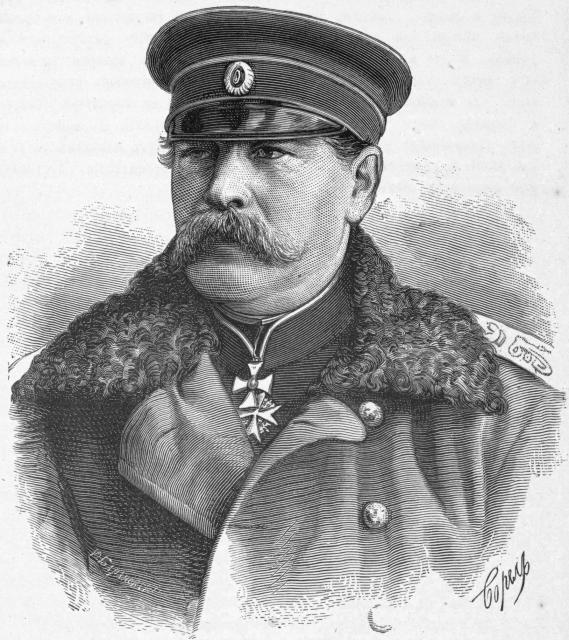
Eduard Totleben
 Russia
- Early Career and Military Engineering
- Caucasus and Crimean War
- Crimean War
- Deploying strong artillery at key points
- Leadership and Engineering Expertise
- Russo-Turkish War of 1877-1878
- Recognition and Legacy
- Scientific and Literary Works
- "Note on Projects for the Armament of Land Fortresses"
Early Career and Military Engineering
Eduard Ivanovich Totleben, a Russian general and renowned military engineer, faced challenges early in his military career. Despite being unable to complete his engineering education at the engineering school due to a heart condition, he joined the Riga Engineering Team in 1840. His work there caught the attention of General Schilder, who tasked him with studying the trench mine system. Totleben's subsequent research led to him commanding a team of sappers in Kiev to conduct large-scale experiments in underground warfare.
Caucasus and Crimean War
In 1848, Totleben traveled to the Caucasus and participated in several expeditions. He played a crucial role in the successful siege of Gergebil, where he established a breach battery 80 yards from the fortress walls. In 1849, he led all operations during the siege of Chokh. Through a daring night reconnaissance, he established an advanced parallel with two breach batteries within 30 yards of the fortress.
Upon his return from the Caucasus, Totleben became an adjutant to General Schilder and later transitioned to the Guards Engineers in 1851. He settled in St. Petersburg, where he supervised the practical work of the Guards Sapper Battalion during camp exercises.
Crimean War
At the onset of the Crimean War in 1854, Totleben was summoned to the headquarters of the Danube Army, where he carried out a series of reconnaissance missions under General Schilder's command. He developed a plan to attack the fortifications at Calafat and played a pivotal role as trench major during the preparatory work for the siege of Silistria. After General Schilder was wounded, Totleben took over supervision of all operations and successfully detonated the entire front of the advanced Arab-Tabia fortification on June 7.
With the siege of Silistria lifted, Totleben was dispatched to Sevastopol, anticipating an enemy landing. Initially, Prince Menshikov, the commander-in-chief, dismissed Totleben's suggestion to begin defensive work, but when the landing occurred, defensive measures were put into action. Totleben expanded the frontal position along the line of the Northern Fort and virtually recreated the defensive line on the southern side.
Due to time constraints, extensive fortification work was not feasible. Totleben employed a strategy of using all available means, including repurposing the armament of the fleet. He established a defensive line based on the following principles:
Selecting a position near the city, determined by existing fortifications
Deploying strong artillery at key points
Connecting these points with trenches for protectionPositioning individual batteries between the main points
Work proceeded continuously day and night, transforming the previously vulnerable cityscape into a formidable defensive line. The Allies abandoned their plan to capture Sevastopol through open assault and commenced siege operations on September 28.
The first bombardment of Sevastopol on October 5 demonstrated the strength of the city's fortifications and its advantageous artillery fire. As the enemy resorted to underground warfare, Totleben countered their efforts with a skillfully prepared network of mine galleries. On June 8, Totleben suffered a gunshot wound to his leg but continued to oversee defensive operations until his condition forced him to leave Sevastopol.
After the fall of Sevastopol, Totleben, now appointed General Adjutant, was summoned to Nikolaev to prepare it for defense. His report on the fortification of Nikolaev became one of his most valuable scientific works, presenting innovative ideas that influenced the development of fortification techniques.
Leadership and Engineering Expertise
Upon his return to St. Petersburg, Totleben assumed responsibility for enhancing the fortifications of Kronstadt. He then spent two years studying German and French fortifications, observing the organization of engineering operations. In 1859, he was appointed Director of the Engineering Department and in 1863, Deputy General Inspector of Engineering.
As political tensions escalated in 1863, Totleben played a significant role in strengthening Russian fortifications. Sveaorg, Dinaburg, and Nikolaev were reinforced, while Vyborg and the mouths of the Neva and Western Dvina Rivers were fortified. Kronstadt's protection against naval attacks was also enhanced. In 1869, he formulated a plan to fortify Kiev.
As chairman of the Artillery Engineering Commission, Totleben actively participated in arming Russian fortresses with rifled guns. He also worked on reorganizing engineering troops in line with contemporary military advancements.
From 1871 to 1875, Totleben developed a new system of defensive lines anchored by major fortress strongholds. He conducted extensive research for this purpose at locations such as Brest-Litovsk, Kovno, Belostok, Goniądz, Grodno, Dubno, and Proskurov. In 1873, a special council on Russia's strategic position, chaired by the Tsar, endorsed Totleben's plan.
Russo-Turkish War of 1877-1878
The execution of Totleben's fortification plan was interrupted by the Russo-Turkish War of 1877-1878. In 1876, he was summoned to Livadia and appointed chief coordinator of the defense of the Black Sea coast. Mines were installed in Kerch, Ochakov, Odessa, and Sevastopol, new batteries were constructed, and armament was increased.
Returning to St. Petersburg in late 1876, Totleben was called back to the war zone in September 1877, following a protracted siege at Plevna. He took command of the siege operations there. After Plevna's surrender, Totleben became the commander of the Eastern Detachment but was soon summoned to St. Petersburg to discuss the potential occupation of the Bosporus and its closure to the British fleet at anchor near the Princes' Islands.
Appointed Commander-in-Chief, Totleben, upon arriving at the army, determined that occupying the Bosporus near Buyukdere was pointless given the impossibility of blocking the strait with mines and securing communication with Russian Black Sea ports. He also believed that the benefits of a successful assault on Constantinople would be temporary, while failure could jeopardize previous campaign achievements.
Instead, Totleben's focus as Commander-in-Chief became supporting Russian diplomacy during negotiations for a peace treaty, pressuring the Turkish government to fulfill Russian demands promptly and precisely, and overseeing the return of Russian troops to their homeland. He also proposed measures to prepare Bulgaria for self-defense after the departure of Russian forces.
Recognition and Legacy
Totleben's contributions during the war of 1877-1878 were recognized with the orders of St. George (2nd degree) and St. Andrew the First-Called. On the 25th anniversary of the first bombardment of Sevastopol, he was elevated to the rank of Count. The renowned Belgian engineer Brialmont acknowledged Totleben as the most remarkable engineer of the 19th century.
In 1879, Totleben became the temporary Governor-General of Odessa and Commander of the Odessa District troops. From 1880 to 1884, he held the same position in the Northwestern Territory (as Governor-General of Vilnius). In his estate in Kėdainiai, he constructed a palace and a minaret between 1880 and 1882 as a monument to the wars against the Turks, reminiscent of the minaret in Plevna that still stands in the city park. The minaret spawned local legends, including one claiming it was built to fulfill the religious needs of a Turkish concubine.
Eduard Ivanovich Totleben passed away in Germany and was initially buried in a chapel-mausoleum in the cemetery of the Lutheran Church in Kėdainiai. His remains were later transferred to Sevastopol for a reburial.
Scientific and Literary Works
Totleben authored several notable scientific and literary works, including:
"Description of the Defense of Sevastopol" (1872, with numerous collaborators)