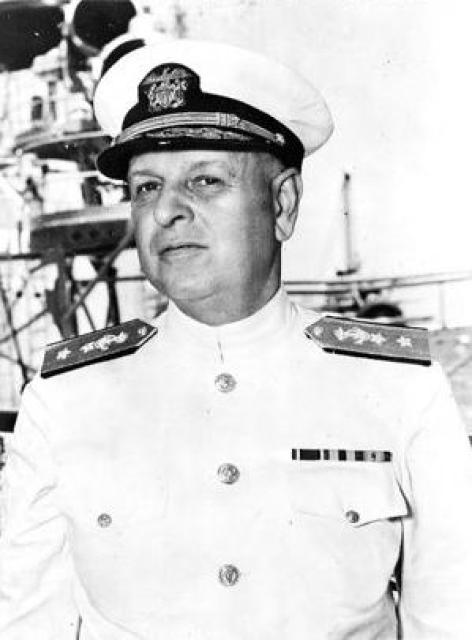
Edward Husband Kimmel
 USA
USA- Early Life and Service
- Pre-World War I Naval Career
- World War I and Postwar Service
- Pacific Fleet Commander
- Pearl Harbor and Controversy
- Post-Naval Career and Death
- Husband Edward Kimmel died in Groton, Connecticut, on May 14, 1968.
Early Life and Service
Husband Edward Kimmel was born on February 26, 1882, in Henderson, Kentucky, to Manning Marius and Sibbie (Lambert) Kimmel. His father, a West Point graduate who had fought in the Civil War, worked as a civil engineer and entrepreneur.
In 1899, Kimmel enrolled at Central University of Kentucky and received an appointment to the United States Naval Academy in 1900. Graduating from the academy in 1904, he served at sea and studied naval gunnery at the Naval War College. He was commissioned as an ensign in 1906.
Pre-World War I Naval Career
From 1906 to 1916, Kimmel held various positions where he earned a reputation as an expert in gunnery and ordnance. He served on battleships such as the "Georgia", "Wisconsin", and "Louisiana," twice serving as the Assistant Director of Target Practice for the Navy Department. He was also the gunnery officer on the armored cruiser "California" and the Pacific Fleet's gunnery officer. He participated in the American landing at Veracruz, Mexico in 1914, and briefly served as Assistant Secretary of the Navy under Franklin Roosevelt in 1915.
World War I and Postwar Service
Upon America's entry into World War I in 1917, Kimmel was sent to Great Britain as a technical adviser on new methods of gunnery control, later becoming the chief of artillery on the staff of the American battleship squadron attached to the Grand Fleet.
After the war, Kimmel held a series of responsible positions, rising to the rank of rear admiral in 1937. He served at the Naval Gun Factory in Washington, commanded a destroyer squadron, attended the Naval War College, was a liaison officer between the Navy Department and the State Department, served as director of fleet movements for the Office of the Chief of Naval Operations, commanded battleships such as the "New York", served as chief of staff of the Battleship Force, and was the Navy's budget officer.
Pacific Fleet Commander
From 1939 to 1941, Kimmel commanded a cruiser division and then the battleships of the Pacific Fleet. Demonstrating his outstanding leadership, Kimmel was promoted to the temporary rank of admiral by Secretary of the Navy Frank Knox and assumed command of the Pacific Fleet and the United States Fleet.
Over the next several months, Kimmel oversaw the intensive training and readiness of the Pacific Fleet, which was based at Pearl Harbor. He also drafted plans for offensive operations in the Marshall Islands in the opening days of war.
Pearl Harbor and Controversy
On December 7, 1941, Japanese carrier-based airplanes caught the American fleet at Pearl Harbor by surprise, crippling all of the Pacific Fleet's battleships. Despite the devastating blow, Kimmel planned to use the fleet's three aircraft carriers, which had been out of the harbor at the time of the attack.
However, Kimmel was relieved of command on December 17 before he could take any action. In early 1942, a special commission appointed by Supreme Court Justice Owen J. Roberts found Kimmel to have been derelict in his duty. Facing the possibility of a court-martial, Kimmel resigned on March 1, 1942, with the permanent rank of rear admiral.
Post-Naval Career and Death
After his resignation, Kimmel worked for a technical consulting firm in New York until 1947. Throughout the 1940s, he faced multiple investigations regarding the events at Pearl Harbor. In 1944, a naval court of inquiry found Kimmel not guilty of any criminal charges and absolved him of responsibility for the disaster. However, Chief of Naval Operations Admiral Ernest J. King revised the verdict, stating that Kimmel had erred by failing to establish effective air patrols north and west of Pearl Harbor, where the attack came from, and by not exercising the prudence that the situation demanded.
Kimmel and his supporters argued that he had not been provided with sufficient intelligence or reconnaissance aircraft and that he had been made a scapegoat for the failures of his superiors. Some even alleged that President Roosevelt knew of the impending Japanese attack but withheld the intelligence from Kimmel in order to provoke the Japanese into firing the first shot and swing public opinion in favor of war with Japan.
Kimmel's critics countered that he had ample information suggesting that American-Japanese relations were nearing a breaking point by early December 1941, but that he had failed to take necessary precautions. Like officials in Washington, Kimmel had been warned that war was imminent but believed that it would take place in the Far East and that an attack on Pearl Harbor was possible but unlikely. By focusing on preparing the fleet to operate in war rather than on preventing a surprise attack, Kimmel bore a significant degree of responsibility for what happened.


