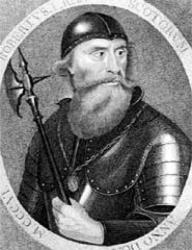
Edward II
 Great Britain
Biography of Edward II
Edward II was the King of England from the Plantagenet dynasty. His main and greatest mistake was his lack of involvement in political intrigues, as he considered politics to be an unbearably boring affair. This fatal neglect greatly affected his reign, which he either ignored or dealt with sporadically.
Early Life and Reign
Edward II was born on April 25, 1284, in Carnarvon Castle in Wales. As the only heir of Edward I, also known as "Hammer of the Scots," and Eleanor of Castile, Edward greatly disappointed his warlike father by showing a strong aversion to any military activities. When Edward I invited Pierre Gaveston to instruct his son in the art of war, a love affair developed between Gaveston and Edward. Although the king sympathized with Gaveston, he was forced to exile him from his court.
On July 8, 1307, Edward II ascended the throne and immediately recalled Gaveston from exile, granting him the county of Cornwall. He also imprisoned his father's Prime Minister and began to drastically change the country's policies, particularly by seeking to end the long-lasting war with Scotland. In 1308, Edward married Isabella of France, the daughter of Philip IV, and they had four children. Edward had little interest in affairs of state and handed over much of the country's governance to Gaveston, who, despite his efforts, managed to make enemies among the powerful barons who had already shown disobedience during Edward I's reign. After a year, the barons united and forced Edward to recognize the authority of the "Ordainers," a council that curtailed Gaveston's powers and severely limited Edward's royal authority.
Turmoil and Downfall
Gaveston returned to the court shortly after his exile, but the enraged barons pursued and killed the king's lover. This cruel act caused a rift within the "Ordainers" government, but it was short-lived. In 1314, during the Battle of Bannockburn, Edward suffered a crushing defeat at the hands of the Scottish king Robert I Bruce, and the barons rallied against him once again. Civil war erupted in England, partly fueled by the barons' hatred for Edward's new favorite, Hugh Despenser the Younger.
Despite the internal conflicts among the barons, Edward seized the opportunity to counterattack. He captured and executed his opposition leader, his cousin Thomas, the Earl of Lancaster. Hugh Despenser returned to the king's side, and Edward established a reign of terror by repealing the "Ordinances," executing his opponents, and confiscating their families' wealth. On September 24, 1326, Edward's estranged wife, Isabella, began a military campaign against him. Troops led by her lover, Robert Mortimer, landed in Harwich and entered London without resistance. Edward was betrayed by his allies. Hugh Despenser was captured and, according to medieval historian Jean Froissart, Isabella, nicknamed the "She-Wolf of France," ordered his genitals to be cut off and burned in front of her before he was beheaded.
Edward fled to the Despensers' castle, where he was captured and imprisoned. Under the threat of the entire dynasty being removed from power, Edward abdicated in favor of his son, Edward III. Confined in Berkeley Castle, Edward made an unsuccessful attempt to escape but was killed on September 21, 1327, by having a red-hot iron rod inserted into his rectum. This horrific execution was not just a punishment, but also a symbolic act representing Edward's punishment for his homosexuality. After his death, Edward's body was displayed to show that he had no wounds, suggesting that he died naturally. However, the cause of Edward's death could hardly be hidden from anyone, as his screams could be heard throughout the castle.
Historian John Boswell writes: "While we cannot assess how his subjects as a whole felt about their king being gay, there is no doubt that his erotic inclinations were widely known at the time and were the cause of his overthrow. The most restrained of his biographers noted in 'The Life of Edward II' that Edward's love for Gaveston, like David's love for Jonathan, was 'superior to love for women.' Another chronicler succinctly mentioned that 'Edward was excessively given to the sin of sodomy and, apparently, was plagued by failures throughout his life.' Ralph Higden explicitly linked Edward's sexual inclinations to his political problems. 'He was passionately in love with one of his friends, whom he exalted, endowed, promoted, and rewarded with extraordinary generosity. This became the cause of Edward's shame, hatred towards his lover, public scandal, and damage to the kingdom as a whole.' In an attempt to soften this harsh evaluation, Boswell admits that 'the unprecedented generosity that Edward allegedly showed to Gaveston was clearly exaggerated by historians, both medieval and modern, in order to intensify disgust towards the nature of their relationship.' A.L. Rowse, a scholar and gay man, author of the book "Homosexuals in History," attempts to rehabilitate this much vilified king: 'He disliked battles and even knightly tournaments, which made him disliked by all sorts of martial fools, especially the barons. His tastes were unpretentious and far from aristocratic. Tall, slim, friendly, he loved walks, sports, horse racing, hunting, and gambling. Unlike most monarchs, he was skilled in various crafts, such as blacksmithing. He enjoyed spending time in cheerful and relaxed company of slightly intoxicated craftsmen, stablemen, and sailors... Apart from a few very close associates, Edward avoided the company of the elite, which offended many. His main and greatest mistake was his lack of involvement in political intrigues, as he considered politics to be an unbearably boring affair. This fatal neglect greatly affected his reign, which he either ignored or dealt with sporadically."
In English history, there were other gay monarchs, including William II, Richard the Lionheart, James I, William III, and possibly George III. I chose Edward II because his image has always had a lasting significance for gay consciousness, from Christopher Marlowe in the 16th century to Derek Jarman in modern times. Partly, this can be explained by the mysterious circumstances of Edward's death, but it is not only that: his loyalty to Pierre Gaveston provides us with a historical example of selfless love that a gay person is capable of.