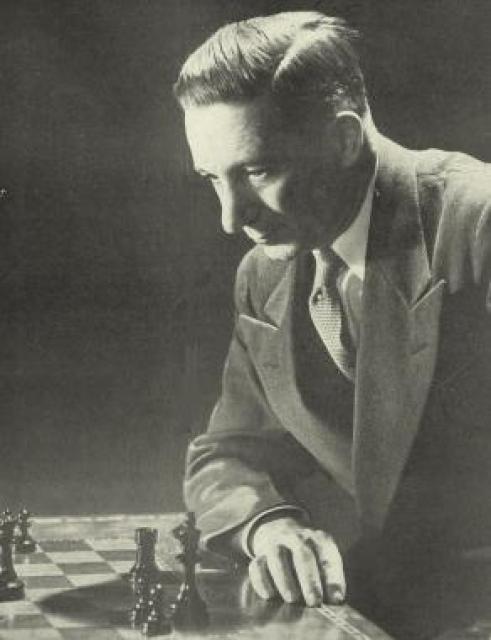
Edward Lasker
 USA
USA- Early Life and Education
- Chess Career
- Famous Match Against George Thomas
- Go Player
- Later Life and Legacy
Early Life and Education
Eduard Lasker was born on December 3, 1885, in Kępno, Poland, to a Jewish family. His father was a physician and his mother was a housewife. Lasker studied in Wrocław, Poland, and Charlottenburg, Germany. He earned a degree in mechanical engineering and electrical engineering from the Technical College of Charlottenburg.
Chess Career
Lasker learned chess from Arnold Schottländer, a German chess master and pupil of Adolf Anderssen. In 1909, Lasker won the Berlin City Championship. In 1911, he published his first book on chess, "Chess Strategy." Between 1916 and 1921, Lasker won the United States Open Chess Championship five times. He was invited to participate in the legendary 1924 New York chess tournament, where he finished 10th out of 11 players.
Famous Match Against George Thomas
One of Lasker's most famous games was against Sir George Thomas, in which he sacrificed his queen in order to hunt down the king. When Lasker delivered checkmate, Thomas remarked, "That was very pretty." Lasker was deeply touched by the sportsmanship of his opponent.
Go Player
Lasker became fascinated with the ancient Chinese game of go. He first learned about it from an article by Oskar Korschelt, who playfully suggested that chess players try their hand at go. Lasker's interest was further piqued when he saw a Japanese newspaper with a diagram of a go game. Together with his friend Max Lange, he studied the diagram but could not initially determine who had won.
With the help of another Japanese customer at a chess cafe, Lasker and Lange realized that the white pieces had actually won. They spent the next three weeks studying the game intently. Lasker and Lange soon became avid students of go, but they were unable to interest other chess players in the game.
In 1909, world chess champion Emanuel Lasker returned to Germany. Lasker told him about his new obsession, and although Lasker was initially skeptical, he quickly recognized the strategic depth of go. Together, they studied the game with the help of a Japanese student, Yasugoro Kitabatake.
Kitabatake arranged a game between Lasker, Emanuel Lasker, and Berthold, Emanuel's brother, against a strong Japanese go player. The Lasker team received a handicap of nine black stones and consulted with each other on every move, but their opponent played effortlessly. After the game, Emanuel Lasker urged Eduard Lasker to travel to Tokyo to continue studying go.
Later Life and Legacy
In 1911, Lasker went to work for the electrical company AEG and tried to arrange a transfer to Tokyo the following year. However, AEG initially sent him to England, where he was stranded during World War I. He was eventually allowed to sail to the United States when Sir Haldane Porter recalled Lasker's victory in the London Chess Championship in May 1914.
Lasker played an important role in popularizing the game of go in the United States. He founded the American Go Association (AGA) with Karl Davis Robinson and Lee Hartman. Lasker lived in the Upper West Side of New York City until his death in 1981. He is known as the "Father of American Go."



