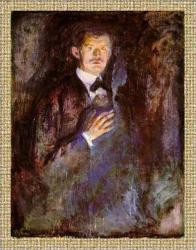
Edward Munch
 Norway
Biography of Edvard Munch
Edvard Munch was a Norwegian painter, graphic artist, and theatrical designer, known for being one of the pioneers of Expressionism. He was born on December 12, 1863, in Loten, southern Norway, and grew up in Oslo (then known as Christiania). His father, a military doctor, was a deeply religious man. When Munch was still a child, his mother and older sister died from tuberculosis. The themes of illness, suffering, and death, which Munch constantly returned to throughout his artistic career, were familiar to him from an early age.

At the age of 17, Munch enrolled in the Royal School of Drawing; during his two years of studies, he became involved in the artistic and literary circles of Christiania, which shocked society with their frank depictions of bohemian life. The subjects that Munch drew from this environment later appeared in his series, "The Life Frieze." According to the artist's intention, each painting in this cycle was meant to portray the helplessness of human beings in the face of indifferent forces of life, love, and death.
In 1889, Munch traveled to Paris, where he became acquainted with new movements in painting, such as Post-Impressionism and the emerging Modernism. In 1892, the artist participated in a major exhibition in Berlin, but his paintings were met with hostility. In Germany, Munch mastered the technique of etching, while in Paris, he experimented with lithography and woodcut, using a characteristic technique, reminiscent of Gauguin, to emphasize the texture of the wood. In his prints, Munch embodied the same subjects as in his paintings but with much greater energy, power, and originality. His prints are perhaps the highest achievement of his mastery.
The central theme in Munch's work became the relationships between men and women. Women in his paintings appeared in various forms: as idealized images of girls, as the personification of erotic female energy, or as clairvoyant, powerful mother figures representing death. In 1908, having achieved wide recognition and popularity in Norway, Munch experienced a strong emotional shock caused by alcoholism and bitter arguments with friends. After spending eight months in a sanatorium near Copenhagen, he returned to Norway and settled in the suburbs of Oslo. The sale of prints and major commissions for monumental decoration of public buildings provided Munch with a stable income. He continued to paint pictures on themes he had developed in his youth and more serene landscapes until his death on January 23, 1944, in Ekely, near Oslo.