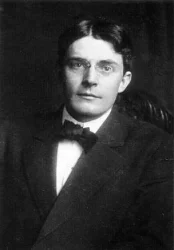
Edward Thorndike
- From ministry family to psychology
- Puzzle boxes and the law of effect
- Applying psychology to education
- Later career and legacy
Edward Thorndike helped turn the study of learning into a measured experimental science. His work with animals produced the “law of effect,” an idea that influenced later behaviorist psychology, while his research on human learning helped shape educational testing in the United States. His legacy is also complicated by his support for eugenics and strong claims about inherited intelligence.
From ministry family to psychology
Thorndike was born on August 31, 1874, in Williamsburg, Massachusetts. His father was a Methodist minister, and his family moved several times during his childhood. He attended Wesleyan University, then studied under psychologist William James at Harvard. He later moved to Columbia University, where he completed a doctoral dissertation on animal intelligence in 1898.
After a brief period teaching elsewhere, Thorndike joined Teachers College at Columbia in 1899. He remained there for most of his academic career, developing psychology courses and applying experimental methods to questions about teaching and learning.
Puzzle boxes and the law of effect
Thorndike’s best-known early studies placed cats in “puzzle boxes” that could be opened by performing a specific action, such as pulling a loop or pressing a latch. At first, the animals tried many actions. Over repeated trials, they escaped more quickly, gradually repeating movements that had led to success.
From these observations, Thorndike proposed the law of effect: responses followed by satisfying outcomes tend to become more likely in similar situations. He described learning as the formation of connections between a situation and a response. The theory helped move psychology toward observable behavior and influenced later research on conditioning and reinforcement.
Applying psychology to education
Thorndike extended his experimental approach to schools. He developed tests and measurement methods for evaluating achievement, intelligence, and other abilities, and wrote influential textbooks and reference works. His work supported a growing movement to use data in curriculum planning and educational administration.
The push to measure ability also reflected assumptions about human difference that are now widely rejected. Thorndike believed many intellectual and moral traits were strongly inherited and supported eugenics, the movement to shape populations through selective reproduction. His involvement in eugenic thinking is a significant part of his record and complicates the legacy of his contributions to psychology and education.
Later career and legacy
Thorndike remained at Columbia until his retirement in 1940 and served as president of the American Psychological Association in 1912. He died on August 9, 1949, in Montrose, New York.
His theories and testing methods left a lasting mark on psychology and schooling. The law of effect helped inspire later theories of learning, and educational measurement became a major field. At the same time, Thorndike’s faith in inherited hierarchies shows how scientific methods can be shaped by the prejudices and political ideas of their era.