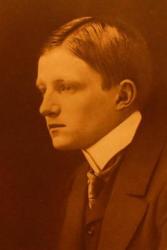
Edwin Arnold
 Great Britain
- Victorian Era English Poet, Journalist, and Publisher
- Teaching and India
- Journalism and Exploration
- The Light of Asia and Orientalism
- Exploration of Eastern Philosophy
- Later Years in Japan
- Honors and Recognition
Victorian Era English Poet, Journalist, and Publisher
Early Life and EducationEdwin Arnold, born in 1832 into a large Victorian family, was the second of six children born to municipal councilor Robert Cole Arnold. Notably, his brother, Edwin Lester Arnold, became a renowned novelist. Arnold's education began at Rochester's King's School, before he matriculated at London's King's College and Oxford University. During his university years (1852), he was awarded the Newdigate Prize for Poetry.
Teaching and India
After graduating, Arnold assumed a teaching position at King Edward's School in Birmingham. In 1856, he embarked on a seven-year journey to India, working at the Government Sanskrit College in Pune. Despite the Indian rebellion of 1857, Arnold remained in India, gathering extensive knowledge of Oriental studies that would later inspire his literary works.
Journalism and Exploration
Returning to England in the early 1860s, Arnold pursued journalism for the Daily Telegraph. He eventually rose to become the newspaper's editor and chief editor, a position he held for over four decades. As a press representative for the Daily Telegraph, Arnold was invited by Henry M. Stanley to join his African expedition, during which they navigated the Congo River Basin. In Arnold's honor, Stanley named a mountain northeast of Lake Edward after him.
Arnold also conceived the idea of an axis linking British territories in Africa from Cairo to Cape Town (1874), a concept that would later be championed by Cecil Rhodes.
The Light of Asia and Orientalism
A passionate admirer of the Orient, Arnold's most notable poetic works, including his celebrated "The Light of Asia" (1879), drew inspiration from Indian culture. He endeavored to promote Eastern customs, philosophies, and ways of life in England, translating Indian languages, including Hindi. "The Light of Asia" achieved immense success throughout the British Empire and the United States.
Exploration of Eastern Philosophy
In his poetry, Arnold explored Indian mythology, philosophy, and the interplay between Christianity and Buddhism, seeking similarities between Christ and Buddha.
Later Years in Japan
Arnold spent his final years in Japan, where he married Tama Kurokawa for the third time. His works "Seas and Lands" (1891) and "Japonica" (1892) provide intriguing glimpses into Japanese society and customs.
Honors and Recognition
Edwin Arnold received the Star of India (1877) and the Indian Empire (1888). He passed away in 1904.