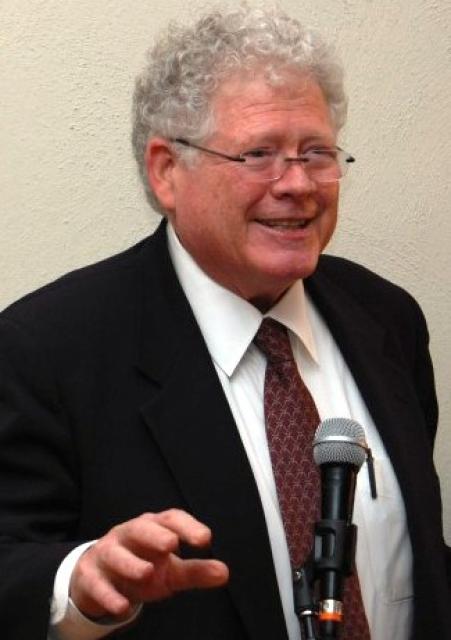
Ehud Kalai
 USA
USA- Ephud Kalai: Pioneer in Game Theory and Economic Behavior
- Early Life and Education
- Career and Research
- Contributions to Game Theory and Economic Behavior
Ephud Kalai: Pioneer in Game Theory and Economic Behavior
Ephud Kalai, an esteemed American scholar, has made significant contributions to game theory, mathematical economics, and related fields.
Early Life and Education
Born in Israel, Kalai relocated to the United States in 1963. He earned his undergraduate degree from the University of California Berkeley in 1967, followed by Master's and PhD degrees in statistics and mathematics in 1971 and 1972, respectively.
Career and Research
From 1972 to 1975, Kalai served as assistant professor at Tel Aviv University. Subsequently, Northwestern University invited him to establish a specialized research group focused on game theory.
Kalai played a pivotal role in founding and leading the Kellogg Center of Game Theory and Economic Behavior. He also holds the position of Executive Director of the Nancy L. Schwartz Lecture Series. As an editor and founder of the journal "Games and Economic Behavior," one of the leading periodicals in game theory, Kalai has gained recognition among his peers.
Contributions to Game Theory and Economic Behavior
In collaboration with Robert J. Aumann, Kalai established the Game Theory Society and served as its president from 2003 to 2006. He is a member of the Econometric Society and has received honorary doctorates from Paris-Dauphine University. He holds honorary positions at the California Institute of Technology and New York University. At Northwestern University, Kalai is a Distinguished Professor of Game Theory and Decision Sciences.
Early in his academic career, Kalai conducted research in cooperative game theory. His development of the Kalai-Smorodinsky solution revolutionized bargaining theory by demonstrating that the long-standing Nash solution is not unique. Kalai continued to work on axioms for egalitarian solutions.
Beyond pure game theory, Kalai successfully applied game-theoretic methods to a variety of disciplines, with notable achievements in mathematical economics. His contributions have significantly advanced our understanding of markets and other cooperative and competitive environments.