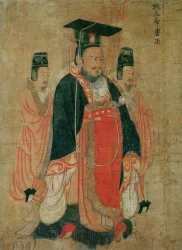
Șehzade Cihangir
- A Prince at the Ottoman Court
- Family Bonds and Court Life
- Death During the 1553 Campaign
- Memorial and Legacy
Şehzade Cihangir lived in the shadow of the Ottoman court’s succession politics, yet his story was shaped more by illness and family ties than by a bid for power. The youngest son of Sultan Suleiman the Magnificent and Hürrem Sultan, he was described as physically disabled and was not sent to govern a provincial district like many Ottoman princes. His early death during his father’s 1553 campaign became linked in later accounts to the execution of his half-brother Mustafa.
A Prince at the Ottoman Court
Cihangir was born in 1531, the youngest surviving son of Suleiman and Hürrem, who became one of the most influential women at the Ottoman court. His brothers included Mehmed, Selim, Bayezid, and Mustafa, the son of Suleiman’s earlier consort Mahidevran. In the Ottoman system, princes were often sent to provincial centers to learn administration and establish a following. Cihangir’s chronic health problems meant that he largely remained near the imperial household instead.
Accounts describe him as having a pronounced physical deformity, often called a hunchback in later sources. Modern writers have proposed possible medical explanations, but no diagnosis can be made with confidence from the historical record. His health appears to have shaped his public role: unlike his brothers, he did not build an independent political base as a provincial governor.
Family Bonds and Court Life
Cihangir was remembered as close to his father. Contemporary reports and later histories describe him accompanying Suleiman during journeys and military campaigns, despite his physical limitations. His relationship with his half-brother Mustafa has also become part of his story. Mustafa was a popular prince and a major rival in the succession struggle, though the extent of his personal closeness to Cihangir is difficult to establish from surviving sources.
The Ottoman court was a family setting and a political arena at once. Suleiman’s sons were potential heirs, and their supporters watched every shift in favor. Cihangir’s poor health made him less likely to contend for the throne, but it did not remove him from the tensions surrounding the succession.
Death During the 1553 Campaign
In 1553 Suleiman led a campaign against the Safavid Empire. During the expedition, the sultan ordered the execution of Prince Mustafa, accusing him of rebellion. The killing shocked the army and court. Cihangir died in Aleppo on 27 November 1553, only weeks after Mustafa’s execution.
Later accounts often say that Cihangir died of grief over his brother’s death. The close timing made the story compelling, but it cannot be confirmed as the medical cause. Reports also describe Cihangir as having serious health problems and suffering a sudden illness. His death deeply affected Suleiman, who had been especially attentive to his youngest son.
Memorial and Legacy
In 1559 Suleiman commissioned the Cihangir Mosque in Istanbul in his son’s memory. Built on a hill overlooking the Bosphorus, it gave the prince a lasting place in the city’s landscape, and the surrounding neighborhood took his name. The original building was later damaged and rebuilt, but the memorial association endured.
Cihangir’s life did not produce a political career or a line of heirs. His place in Ottoman history rests on his position within Suleiman’s family, his physical vulnerability at a court where princes were expected to command, and the grief associated with his death. The mosque that bears his name preserves the memory of a prince whose brief life was bound to one of the most turbulent succession episodes of Suleiman’s reign.