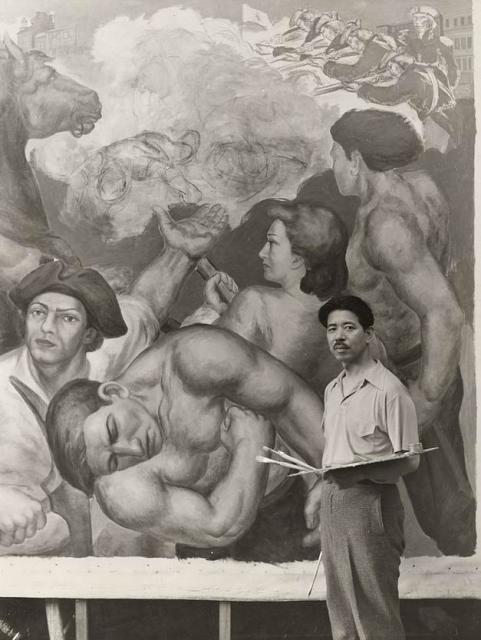
Eitaro Ishigaki
 Japan
Japan- Birth and Early Life
- Early Career and Influences
- Activism and Art
- Artistic Collaborations and Recognition
- Internment and Return to Japan
- Artistic Style and Themes
Birth and Early Life
Eitaro Ishigaki, a Japanese artist, was born in Taiji, Wakayama Prefecture, in 1893. In 1909, he relocated to the United States with his father.
Early Career and Influences
From 1910 onwards, Ishigaki engaged in temporary jobs while pursuing his artistic aspirations. In 1914, he enrolled at the California School of Fine Arts, where he befriended prominent Japanese socialist Sen Katayama. In 1915, he became a student of John Sloan at the Art Students League in New York City.
Activism and Art
Ishigaki's connection to Katayama extended beyond art. In 1918, he joined the Socialist Association, founded by Katayama, and worked as a typesetter for the Japanese weekly, New York Shimpo. The following year, he co-founded a labor magazine, Kyōzon.
Artistic Collaborations and Recognition
In 1929, Ishigaki co-founded the John Reed Club, collaborating with Mexican artists José Clemente Orozco and Rufino Tamayo. His work gained wider recognition in 1935, when he created a mural for the Justice House in Harlem under the Works Progress Administration (WPA). In 1936, he played a role in organizing the American Artists' Congress and served on its exhibition committee.
Internment and Return to Japan
With the outbreak of World War II and the United States' conflict with Japan, Ishigaki, as a Japanese citizen, was interned in 1941. After being released under certain conditions in 1951, he returned to Japan and settled in Mitaka, near Tokyo.
Artistic Style and Themes
Ishigaki's early works exhibited influences from Futurism. However, his more mature works were characterized by a realistic style that depicted social struggles, injustice, and the lives of working people.