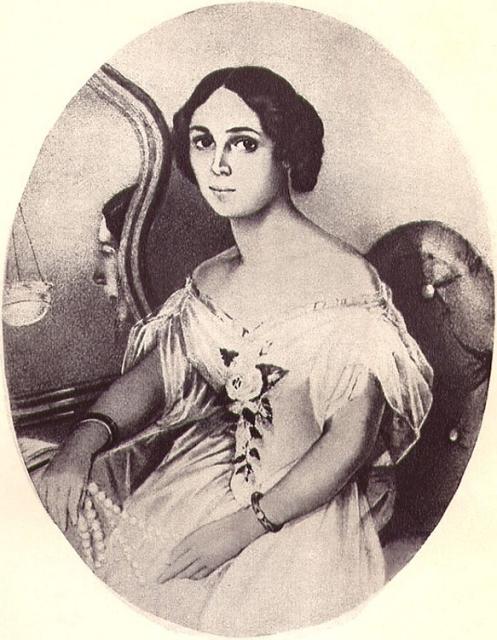
Elena Denisieva
 Russia
Biography of Elena Denisieva
Elena Alexandrovna Denisieva was born in 1826 into an ancient but impoverished noble family. She lost her mother at a young age, and her relationship with her father, Alexander Dmitrievich Denisiev, a distinguished military officer, and his second wife did not go well. Elena, rebellious and impulsive, was quickly sent to St. Petersburg to live with her aunt, Anna Dmitrievna Denisieva, the chief inspector of the Smolny Institute.
As the senior governess of the prestigious institution, Anna Dmitrievna had the privilege to raise Elena alongside the other "Smolny girls". Elena acquired impeccable manners, a graceful posture, excellent French and German pronunciation, a mixture of scientific and mathematical knowledge, and solid skills in housekeeping and cooking. She also developed a passionate imagination through her secret nighttime readings of sentimental novels and poetry. Anna Dmitrievna, strict and aloof with her subordinates and pupils, developed a deep attachment to her niece, spoiling her with clothes, jewelry, and taking her out into society, where Elena, an elegant and graceful brunette with expressive eyes, quickly attracted the attention of experienced suitors and ardent admirers.
One such admirer was Fyodor Ivanovich Tyutchev, a renowned poet, brilliant wit, and diplomat often referred to as the "heir to Pushkin's traditions." Little is known about Elena Alexandrovna Denisieva, the last, intense, secret, and tormenting love of Tyutchev. She became the recipient of more than fifteen of his poems, which became priceless masterpieces of Russian poetry in the second half of the 19th century. This was a significant achievement for a woman who loved unconditionally. Yet, it was too little for a heart that was torn apart by this love. For almost two hundred years, we have been reading the lines dedicated to her, marveling at the passionate and burning strength of Tyutchev's feelings for her. However, we rarely question who this woman was, what she represented, and what she could do to captivate, attract, and enchant such an ever-changing and restless nature.
Let us try to turn the pages of her few memories, forgotten letters, and yellowed pages of other people's diaries: carefully, unobtrusively. Let us attempt to recreate the hidden canvas of her brief, painfully bright life, which the poet called "my living soul." Elena Alexandrovna Denisieva was born in 1826 and died on August 4, 1864, in St. Petersburg. Her father disowned her and forbade her relatives from seeing her after her relationship with Tyutchev became known. She had almost no friends or acquaintances in society. Only two or three close friends and a few relatives visited her in her new apartment, where she lived with her aunt and her newborn daughter, also named Elena.
Elena's life was filled with hardships and exclusion. She found solace in her deep religious beliefs, prayer, charity work, and donations to the icon of the Mother of God in the cathedral of the educational institutions near the Smolny Monastery. She was aware that she was deceiving herself, but her heart, torn apart and too passionate, carefully constructed its own "theory" to sustain her during the difficult and selfless fourteen years of her love affair.
Elena Alexandrovna knew that she was living a life of self-deception, but her heart, overwhelmed by her intense feelings, believed that she was more his wife than all his previous wives. She lived his life, understood every sound, every intonation of his voice, every expression on his face, every glance and smile. She considered herself one with him, and he belonged to her. She forgave him for everything: his frequent absences, his dual life, his selfishness, his absent-mindedness towards her, and even the occasional coldness towards her. She even had to lie to her children, answering their questions about their absent father by saying he was busy with work. The only place where she could be free from judgment, pity, and alienation was when she was with Tyutchev abroad, spending several months each year together. There, she proudly signed the hotel register as "Madame Tutchef, with her family."
However, within the circle in which Elena Alexandrovna Denisieva lived in Russia, she was always an outcast, rejected and stumbled upon. Undoubtedly, Elena, a highly intelligent and perceptive woman, knew that she was deceiving herself. Yet, her torn and passionate heart carefully constructed its own "theory" to sustain her during those challenging and selfless fourteen years.


