Elena Romanova
 Russia
- Great Princess Elena Pavlovna: A Royal Life Cut Short
- Birth and Early Life
- Marriage to the Duke of Mecklenburg-Schwerin
- Life in Mecklenburg-Schwerin
- A Brief Life and Unforgettable Legacy
Great Princess Elena Pavlovna: A Royal Life Cut Short
Amidst the vast pages of history, there are entries so brief that time skips over them with an air of indifference, its smile tinged with contempt. "What is this?" it seems to murmur. "A life? No, not even that. A mere footnote?"
Such was the destiny of one such "footnote," the ephemeral existence of a celestial shadow that vanished from Earth before it could fully take shape. Her biography, scarcely begun, faded into obscurity before it could truly blossom.
Birth and Early Life
On December 13, 1774, in Gatchina's Pavlovsky Palace, the Russian throne's heir, Grand Duke Pavel Petrovich, and his wife, Maria Feodorovna, welcomed a baby girl into the world. They named her Elena, for her extraordinary features, which astonished her parents and even the reigning Empress Catherine the Great.
Recognized as a future beauty, Elena was closely observed by Catherine, who detected unique qualities in her personality that others may have missed.
Marriage to the Duke of Mecklenburg-Schwerin
In keeping with Russian custom, Elena was not to marry within the court to prevent powerful aristocratic factions from gaining influence over the sovereign. Thus, from the age of eight, a suitable match was sought.
The search was arduous, as the условие or condition for such a royal marriage was both simple and complex: the bride must not forsake her Orthodox faith. This stringent requirement made it nearly impossible for Elena to aspire to a crown of great significance.
Instead, her attention turned to a small principality, Mecklenburg-Schwerin. Despite its diminutive size, there was a challenge: the young princesses were accustomed to the opulent lifestyle of the glittering St. Petersburg court.
Nevertheless, as fate would have it, all five of Catherine's granddaughters rose to the occasion.
Life in Mecklenburg-Schwerin
From childhood, Elena's soul had been entrusted to the strict Countess Charlotte Karlovna Lieven, who instilled in her a profound appreciation for beauty.
Countess Lieven recognized Elena's sensitivity and brought it to the attention of her grandmother, who had a particular fondness for the young princess. Catherine ordered Elena's room to be exquisitely decorated, filled daily with flowers, and taught her the art of arranging bouquets.
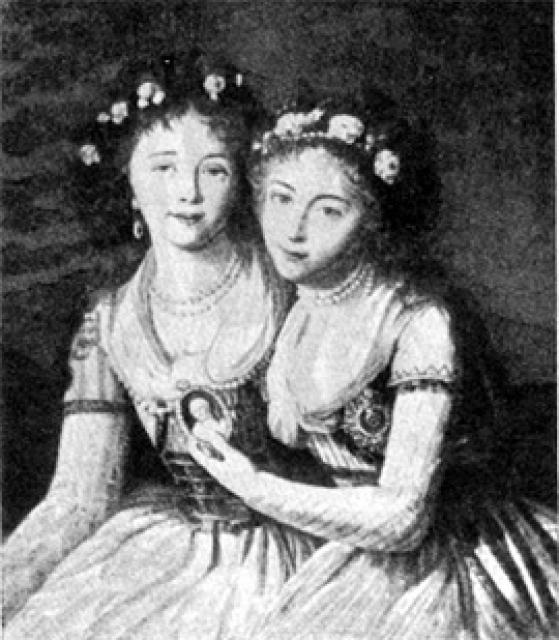
Elena's beauty and charm captivated all who encountered her. Her portraits, painted by illustrious artists such as Elisabeth Vigée-Lebrun and Vasily Lukich Borovikovsky, circulated among European courts.
In 1799, Elena became the bride of Frederick Louis, Hereditary Duke of Mecklenburg-Schwerin. Despite his shortcomings, the Duke was deeply enamored with Elena.
Their marriage was strategically important for Russia, as it solidified ties with European courts and secured Mecklenburg-Schwerin as a valuable outpost on the border with Sweden.
A Brief Life and Unforgettable Legacy
Elena's charm and kindness extended not only to her husband but also to their court and subjects. Despite her upbringing in luxury, she embraced her new life with humility and grace.
Her sudden passing in October 1803, at the tender age of 28, left an immeasurable void. Her legacy, though brief, continues to inspire generations to come.




