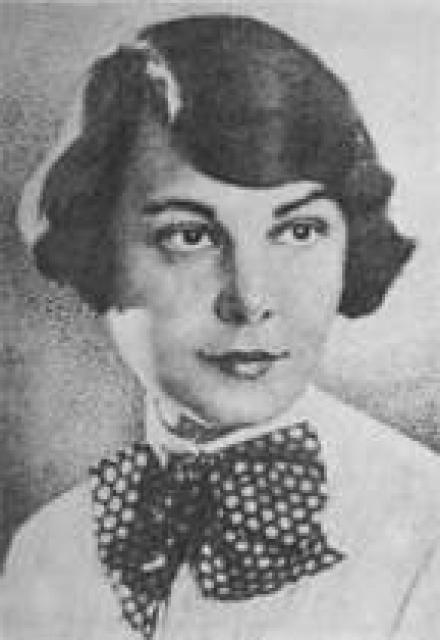
Elena Teliga
 Ukraine
Biography of Elena Teliga
Elena Teliga was a Ukrainian poet and literary critic. She was born on July 21, 1906 in the village of Ilyinskoye near Moscow, where her parents were spending their summer vacation. The exact location of her birth is unknown as her birth certificate has been lost. Her mother was the daughter of an Orthodox priest, and her father was a hydroengineer who worked on various rivers in Russia. Elena had a younger brother who was also a poet but was not as well-known as her.
In 1911, Teliga's family moved to St. Petersburg and then to the Ukrainian city of Izium in May 1917, where her father worked at the Kiev Polytechnic Institute. Teliga attended the Alexandra Duchinska Women's Gymnasium in Kiev, where she studied Ukrainian, Russian, German, and French. In 1919, private education in Ukraine ceased, and Teliga had to transfer to a public school.
In May 1922, Teliga's father emigrated to Czechoslovakia, and her mother, along with Teliga and her brother Sergey, followed suit. They initially settled in Tarnów, Poland, before moving to Poděbrady, Czechoslovakia, where Teliga's father worked at the Ukrainian Agricultural Academy. In the same year, Teliga received her high school diploma and enrolled in the history and philology department of the Ukrainian Pedagogical Institute named after Mykhailo Drahomanov in Prague. It was there that she met her future husband, Mikhail Teliga, a Kuban Cossack and former sotnik of the Ukrainian People's Republic Army. They got married on August 1, 1926.
During this time, Teliga's poetry and literary works were published for the first time in Czechoslovakia. In the fall of 1929, Teliga and her husband moved to Warsaw, where her parents had been living since 1928. In Warsaw, she experienced financial difficulties and worked as a performer in night cabarets and as a mannequin. Eventually, she found a job as a teacher for primary school children.
In December 1939, the Teliga couple moved to Krakow, where Elena reunited with Oleg Olzhych, a prominent figure in the Ukrainian emigrant culture, and joined the Organization of Ukrainian Nationalists (supporters of A. Melnyk), of which Olzhych was a member of the board. When Hitler invaded the USSR, some supporters of the organization had illusions that the Germans would help restore an independent Ukrainian state, as it had been in 1918. Teliga also held such mistaken beliefs. On October 22, 1941, she arrived in Kiev with a group of supporters of A. Melnyk, organizing the Union of Ukrainian Writers, opening a food distribution point for her fellow activists, collaborating with the editorial office of the newspaper "Ukrainian Word" (editor Ivan Rogach), and publishing the weekly literary and art magazine "Litavry." In her articles, she expressed hope that the collapse of Bolshevism would contribute to the revival of Ukrainian culture.
Teliga ignored the decrees of the German authorities, and eventually, "Litavry" was banned. On February 9, 1942, Elena Teliga was arrested. Her husband voluntarily surrendered to the Gestapo and identified himself as a writer. On the wall of her cell, she drew a trident and left a message: "Here sat Elena Teliga, going to execution." She was executed along with her husband and colleagues (Ivan Rogach, Vladimir Bagaziy, and others) in Babyn Yar on February 21, 1942.


