Hamid Alimdzhan
 Uzbekistan
- Biography of Hamid Alimdzhan
- Moving to Tashkent and Literary Career
- Career as a Literary Figure
- Literary Contributions
Biography of Hamid Alimdzhan
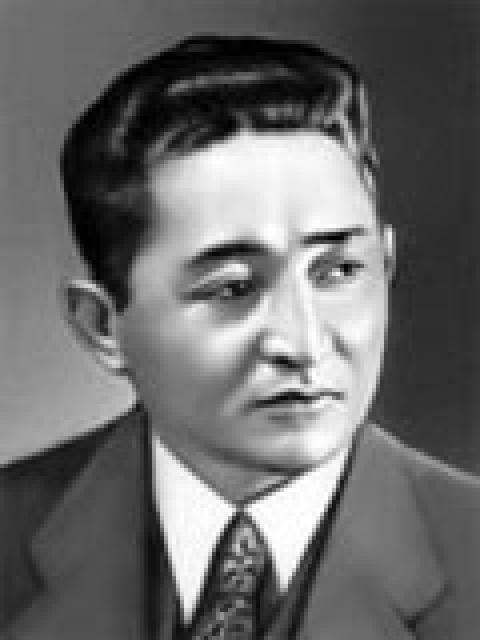
Early Life and EducationHamid Alimdzhan (born Hamid Alimdzhanovich Azimov) was an Uzbek poet, playwright, and literary critic, and a representative of the Uzbek poetic classicism of the 20th century. He was born in 1909 in Jizzakh. From an early age, he was exposed to numerous folk tales, dastans, and songs from his mother Kamila and grandfather Mulla Azim. As he became a writer, he turned to folklore both as a collector and as a researcher. In 1918, Alimdzhan enrolled in an incomplete secondary school that had just opened in Jizzakh, and later went to study in Samarkand, first at a college and then at the university. He studied at the Uzbek Pedagogical Academy in Samarkand from 1928 to 1931. In 1928, his first collection of poetry, "Spring," was published. Many years later, Aibek emphasized the symbolic nature of this title in his article about Hamid Alimdzhan. "Spring" was released when the author was experiencing his own "spring" period. The collection corresponded to the optimistic and romantically elevated mood of the poet.
Moving to Tashkent and Literary Career
The completion of his studies in Samarkand and his move to Tashkent marked the beginning of a new and significant biographical and creative stage for Alimdzhan. "Hamid," Uygun recalls, "came to Tashkent after me. It was a difficult time: there was a shortage of paper. We wrote on long narrow scraps that we obtained from the printing house, but we wrote well; perhaps that is why both I and Hamid have always had a fondness for narrow, long strips of paper." Alimdzhan worked extensively as a journalist and editor for newspapers and magazines while continuing his literary work. In the 1930s, he created major works inspired by his impressions of dastans performed by bakhshis: "Aigul and Bakhtiyar," "Simurgh."
Career as a Literary Figure
In 1939, Hamid Alimdzhan became the responsible secretary of the Union of Writers of Uzbekistan, a position he held until his death in 1944. His poetic works were influenced by M. Gorky and V. V. Mayakovsky. Hamid Alimdzhan was one of the first Uzbek poets to embark on the search for poetic forms that could fully reflect the contemporary world. His first collection of poems, "Spring," was published in 1926, but the author's talent manifested itself in his poems "Simurgh" (1939), "Aigul and Bakhtiyar" (1938), "Edge" (1939), and "Happiness" (1940). His best work, the poem "Zaynab and Aman," synthesized the characteristics of Uzbek poetry in the 1930s (1938). During the war with fascist Germany, he wrote the poem "Tears of Roxana" (1944), the collection of poems "Take Up Arms" (1942), and the historical drama "Mukanna" (1942-1943), which were noted for their mature craftsmanship.
Literary Contributions
In his literary articles, Alimdzhan developed problems related to classical and contemporary Uzbek literature, the interconnection of literature and folklore, and Russian and Uzbek literature. He translated "The Prisoner of the Caucasus," "The Mermaid" by A.S. Pushkin, "Belou" by M.Yu. Lermontov, and "Chelkash" by M. Gorky into Uzbek. The Tashkent Metro station is named in memory of Hamid Alimdzhan.