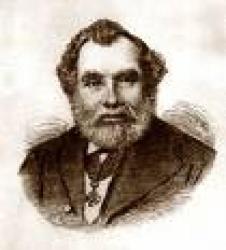
Elias Lenrott
 France
Biography of Elias Lönnrot
Early Life and EducationElias Lönnrot, the prominent figure of Finnish culture, was born into a poor family in the village of Sammatti in the former Nyland province. Despite his humble beginnings, Lönnrot was a brilliant scholar and went on to become an exceptional researcher of the Karelian-Finnish epic poem "Kalevala." He was also a linguist and had a medical education.
Lönnrot completed his schooling first in Tammisaari and later in Turku. He then enrolled in the University of Turku in 1822 and graduated in 1827. He resumed his studies in the field of medical sciences at the University of Helsinki and completed his degree in 1832.
Work and Achievements
In early 1833, Lönnrot became a district doctor in Eastern Finland, in the small town of Kajaani. He lived there for 21 years, until the end of 1853, which proved to be the most fruitful period of his life. During this time, Lönnrot undertook extensive work in collecting folklore and the epic poem "Kalevala," which brought him worldwide fame.
Lönnrot embarked on 11 journeys across Finnish and Russian Karelia between 1828 and 1842, mostly on foot with a rifle and backpack or by boat. These travels were undertaken with the purpose of folklore and linguistic research. His travel journals and notes, most of which were published, contain a wealth of geographical and local knowledge, including information about routes, means of transportation, landscapes, lakes, rivers, settlements, population, their lifestyle and livelihoods, economic conditions, customs, and the state of medical assistance, among other things. Some of his observations, particularly those regarding the Upper Kemijoki river basin, retain their historical and geographical value.
Travels and Publications
In Lönnrot's first journey in 1828, he partially explored Ladoga Karelia, and in his second journey in 1832, he visited Reboly, Kaskesnavolok, Minozero, and Babja Guba (Lake Kamennoye) before returning to Finland through Lenderi, Kajaani, Kuopio, Porvoo, and Helsinki. In 1833, Lönnrot conducted a major folklore expedition to record the songs-runes of "Kalevala," traveling from Kajaani to Russian Karelia via Vuokki, Kamennoye, Voinitsy, and Voknavolok (Lake Verkhneye Kuyto) and returning home via Kamennoye Lake.
Lönnrot's fifth journey in April 1834 took place mostly in Russian Karelia and lasted for 18 days. He visited Voinitsa, Yuvaksha, Ukhta, Voknavolok, Kamennoye Lake, and Ladoga Lake in the upper part of the Kemi River basin. It was during this trip that Lönnrot met the famous Karelian rune singer, Arhip Pertunen.
In his subsequent journeys, Lönnrot focused on philological research of Karelian dialects and collecting materials for a comprehensive Swedish-Finnish dictionary. In 1841, he visited Petrozavodsk. Lönnrot compiled and published the collected runes of the great Karelian-Finnish epic poem "Kalevala" initially in 1835 and completed it in 1849.
Apart from his major works, Lönnrot also published collections such as "Finnish Folk Proverbs" (1842), "Finnish Riddles" (1844), and others. As a physician and naturalist, he authored "A Finnish Peasant's Home Doctor" (1839) and "Flora of Finland" (1860). In 1841-1842, Lönnrot, along with M. Castrén, undertook a significant ethnographic-linguistic journey to Lapland. In the academic world of his country, Lönnrot stood out for his profound knowledge of the Finnish language and folklore. In 1853, he was invited to be a professor of Finnish language and literature at the University of Helsinki. He left this position in 1862 and returned to his hometown of Sammatti, where he passed away at the age of 82. In 1876, Lönnrot was elected an honorary academician of the Russian Academy of Sciences. His long-standing friendship with the Russian scholar J. K. Groth and his connections with several Russian writers, such as P. A. Pletnev and P. A. Kulish, held significant historical and literary importance.