Elisabet Thuringen
 Germany
- Biography of Saint Elizabeth of Hungary
- A Life of Charity
- Married Life and Charity
- Ruling and Charity
- A Life of Service
- Legacy and Patronage
Biography of Saint Elizabeth of Hungary
Princess of the House of ÁrpádElizabeth of Hungary was born on July 7, 1207, in Bratislava or Šaľa, according to different sources. She was the daughter of Andrew II, King of Hungary, and Gertrude, making her a princess from the Hungarian dynasty of Árpád. From a young age, Elizabeth lived at the court of the Landgraves of Thuringia in Marburg and the Wartburg Castle near Eisenach. She was considered a prospective wife for Prince Ludwig.
A Life of Charity
In 1223, Elizabeth was introduced to the ideals of poverty and mercy preached by the Franciscan monks. This had a profound impact on her, and she decided to live in accordance with their spirit, helping the poor and needy. Conrad of Marburg, a stern preacher of the Crusades and an inquisitor, had a significant influence on Elizabeth. She founded a large hospital for the poor in Eisenach, and dedicated her free time to serving the destitute. She is often depicted in prayerful images surrounded by beggars and the disabled, waiting for healing.
Married Life and Charity
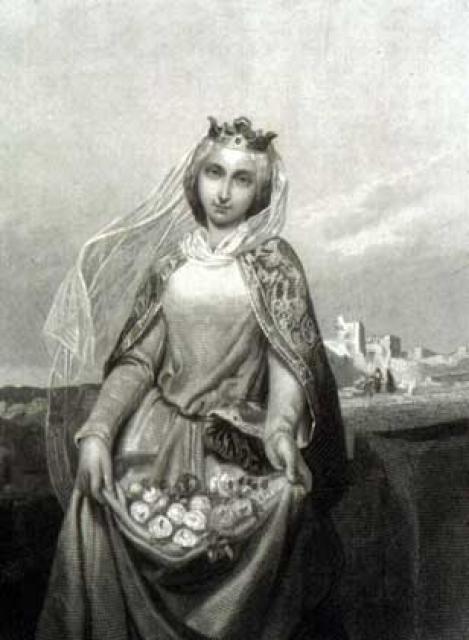
Elizabeth married Ludwig when she was 14 years old. Despite her husband's initial disapproval of her charitable acts, he eventually relented after witnessing miracles associated with her compassion. Elizabeth's acts of mercy included giving bread to the poor, even carrying it in her apron. Legend has it that when her husband discovered the bread, it miraculously turned into roses. This story, however, is also associated with her great-niece, Isabella of Portugal.
Ruling and Charity
In 1226, Ludwig went to Cremona to represent Emperor Frederick II at the Imperial Diet of the Holy Roman Empire. Elizabeth took charge of governing Thuringia during his absence, amidst famine and epidemics caused by severe flooding. She ordered generous alms to be distributed throughout her territory, even giving away her own clothes and church utensils to help those in need. Ludwig later participated in the Sixth Crusade but fell ill with the plague in Otranto, Italy, and died.
A Life of Service
After Ludwig's death, Elizabeth was removed from court, but instead of returning to Hungary or entering a convent, she took a vow of chastity and decided to serve the destitute. She became a member of the Third Order of St. Francis, making her the first German Franciscan tertiary. In 1228, she founded a hospital for the poor in Marburg, where she worked alongside others. Elizabeth cared for the sick and collected donations for the hospital's needs. She passed away on November 17, 1231, in Marburg at the young age of 24.
Legacy and Patronage
In 1235, Elizabeth was canonized by Pope Gregory IX. During the Protestant Reformation in 1539, her relics were seized and desecrated but were later returned to Marburg. Today, her relics are also preserved in Vienna, Brussels, Viterbo, and the Church of St. Cäcilia in Düsseldorf-Benrath. Elizabeth is considered the patroness of Franciscan tertiaries, healthcare workers, bakers, and charitable organizations. Her feast day is celebrated on November 17, and she is particularly revered in Germany as the patroness of Thuringia and Hesse. Her image is widely represented in the art of Northern Europe and is a symbol of feminine mercy for the Franciscans. The famous Blue Church in Bratislava is dedicated to her memory.