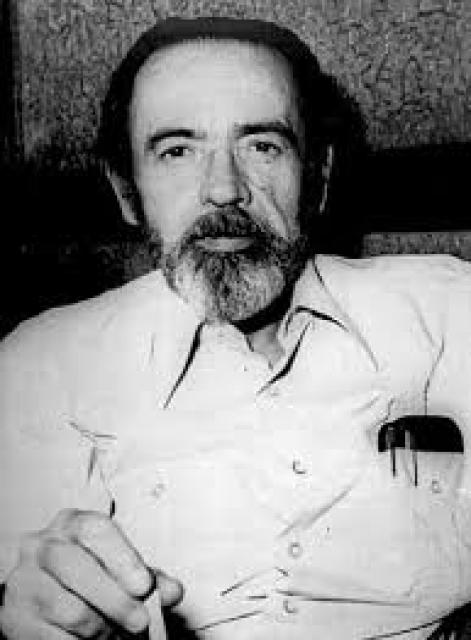
Eliseo Diego
 Cuba
Cuba- Eliseo Diego: A Prolific Cuban Writer
- Education and Literary Beginnings
- Literary Career
- Post-Revolutionary Cuba
- International Recognition
- Legacy and Awards
Eliseo Diego: A Prolific Cuban Writer
Early Life and FamilyEliseo Diego was a Cuban poet, prose writer, translator, and author of children's books. Born into a wealthy family in Havana, Eliseo grew up in a countryside home surrounded by the love of his family. His father, a Spanish immigrant who established a furniture factory in Cuba, took the family on trips to Europe, where Eliseo was exposed to different cultures.
Education and Literary Beginnings
Diego's education began at the prestigious Colegio Luz where he befriended the future poet Cintio Vitier. Together, they established the literary magazine "Origenes" in 1936. In 1939, Diego graduated from the Havana Institute and enrolled in the law faculty at the University of Havana, but later abandoned his studies. During his university years, he met the Garcia Marruz family, whose daughters later married his friends.
Literary Career
Eliseo Diego's literary career began with the publication of his short story collection, "En las oscuras manos del olvido," in 1942. In collaboration with José Lezama Lima and Cintio Vitier, he founded the influential literary magazine "Orígenes" in 1944. In 1952, he graduated from Wingate College in North Carolina, fulfilling his mother's wish for him to teach English.
Post-Revolutionary Cuba
After the Cuban Revolution in 1959, the "Orígenes" magazine faced ideological criticism, and Diego's circle of publishers and authors became targets. He worked at the National Library of Cuba from 1962 to 1970, translating Russian and English literature. He also penned children's books and translated his poems into English.
International Recognition
Despite a period of silence from 1958 to 1966, Diego's work gained international recognition. He visited the USSR multiple times and forged friendships with Gabriel García Márquez in 1975 and Ray Bradbury in 1991. His poetry and prose were translated into numerous languages.
Legacy and Awards
Eliseo Diego passed away in 1994, leaving behind a prolific body of work. He received the Maxim Gorky Prize for his translations of Russian poetry in 1979, the Cuban Critics Prize (1982, 1988, 1989), the National Literature Prize (1986), the Juan Rulfo Prize (1993), and various other accolades. His son, Eliseo Alberto, is an acclaimed writer.