Elizabed Vije-Lebren
 France
- Biography of Elisabeth Vigée-Lebrun
- Portraitist and Court Painter
- Life and Travels
- Renowned Portraitist and Academic Achievements
- Written Legacy
Biography of Elisabeth Vigée-Lebrun
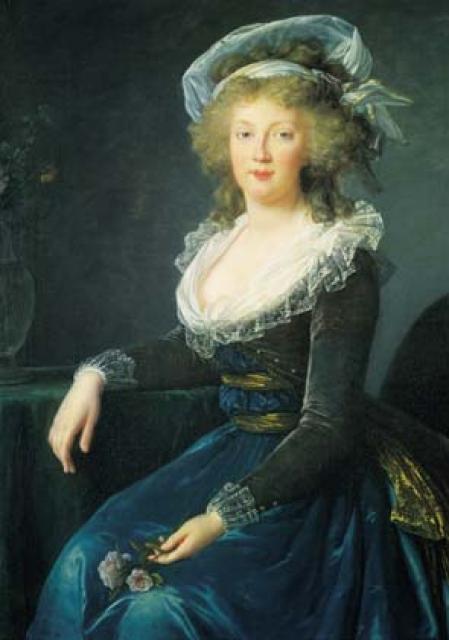
Elisabeth Vigée-Lebrun was a French artist who was known for her portraits and was a representative of sentimentalism in classicism. She was born on April 16, 1755, in Paris, into the family of the artist L. Vigée. In 1776, she married a picture dealer, J. Lebrun. Elisabeth received her artistic education from her father, who painted pastel portraits, as well as from G. Briard and G. F. Duayen. She was also influenced by J. B. Greuze.
Portraitist and Court Painter
In 1779, Elisabeth was invited to Versailles to create a portrait of Queen Marie Antoinette. She became friends with the queen and painted around 25 portraits of her, some of which are now kept in the museum of the Palace of Versailles. Elisabeth's career skyrocketed, and she became a court painter even before being admitted to the Academy in 1783.
Life and Travels
After the French Revolution, Elisabeth emigrated and lived in Italy from 1789 to 1793, Vienna from 1793 to 1794, St. Petersburg from 1795 to 1802, England from 1802 to 1805, and Switzerland from 1808 to 1809. She briefly returned to Paris in 1802 but finally settled back in her homeland in 1810.
Renowned Portraitist and Academic Achievements
Elisabeth Vigée-Lebrun was beloved by European nobility and became a member of many art academies, including an "honorary free associate" of the St. Petersburg Academy. She skillfully combined classical idealization with sentimental sensitivity and the "poetry of the heart," softening even the most formal of her subjects.
Some of her notable works include "The Artist G. Robert" (1788, Louvre, Paris), "G. A. Stroganov" (1793), "A. S. Stroganova with her Son" (1793), "Empress Elizabeth Alexeievna" (1795), "Daughters of Paul I, Grand Duchesses Alexandra Pavlovna and Elena Pavlovna" (1796), and "Empress Maria Feodorovna" (1799) - all portraits are housed in the Hermitage Museum, St. Petersburg. Elisabeth also painted several remarkable self-portraits, such as "Self-Portrait with Her Daughter" (1787, Louvre) and "Self-Portrait of the Artist, Painting Empress Elizabeth Alexeievna" (1800, Hermitage). She also experimented with landscape painting. In her later years, she stopped painting.
Written Legacy
Elisabeth Vigée-Lebrun wrote her memoirs titled "Memoirs of My Life" (1835-1837), which are filled with vivid and lively historical and artistic accounts.