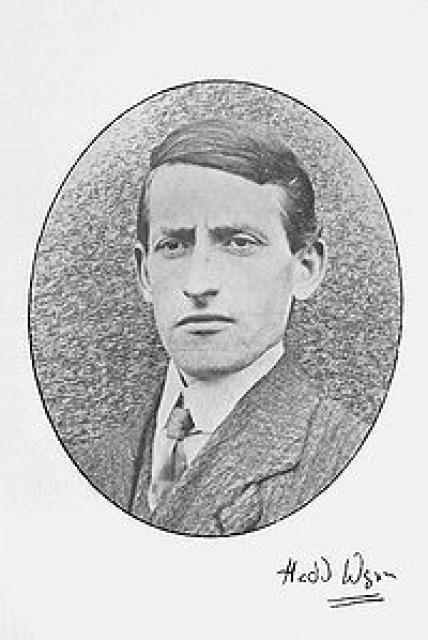
Ellis Evans
 Great Britain
- Biography of Ellis Evans
- Early Life and Poetry
- War and Death
- Poetic Legacy
- Recognition and Commemoration
Biography of Ellis Evans
IntroductionEllis Evans, also known by his bardic name Hedd Wyn, was a Welsh poet who tragically died in the First World War. He was born in 1887 on a farm near Trawsfynydd in Merionethshire, in northwest Wales. Despite not receiving a formal education, Evans displayed exceptional talent as a poet.
Early Life and Poetry
Evans spent his childhood helping his parents on the farm where he was born. He briefly attempted to work in the coal mines of South Wales for better wages but eventually returned home. In 1907, Evans won his first poetry competition at a local cultural festival called Eisteddfod in the nearby town of Bala. Over time, his poetic skills continued to develop, and he went on to win several Eisteddfod competitions in Llanuwchllyn, Pwllheli, and Pontardawe. In 1916, he narrowly missed becoming the winner of the National Eisteddfod, which took place in Aberystwyth.
War and Death
Although Evans had no desire to go to war, he couldn't ignore the call of duty when the First World War began. In his poem "Y Rhyfel" ("The War"), one can hear the bitterness he felt about living in such difficult times. Despite his reluctance, Evans wrote several elegiac verses in memory of the Trawsfynydd residents who lost their lives in the war. In 1916, it became clear that Evans couldn't avoid conscription. Since there was not enough work on the farm to keep all his siblings occupied, he was enlisted into the Royal Welsh Fusiliers. After completing his training in Liverpool, he was sent to the front in Saint-Iler. On July 17th, 1916, during a British offensive, Ellis Hamffri Evans was killed. Initially buried on the battlefield, his remains were later transferred to a military cemetery near Boezinge.
Poetic Legacy
During his training in Liverpool, Evans was granted a week-long leave, during which he wrote a long poem called "Yr Arwr" ("The Hero") based on his war experiences. He managed to send it to the National Eisteddfod competition in Birkenhead in 1917. After his death, it was announced that his poem had won the competition. As a tribute, the traditional carved chair for the "chief bard" was covered in black cloth, and the poets placed their englyn (a Welsh verse form) in praise of him on the throne. The chair was later sent to Evans' family home, where it is still kept today. In 1918, a collection of Evans' works titled "Cerddi'r bugail" ("Songs of the Shepherd") was published. In 1923, a memorial was erected in Trawsfynydd using the proceeds from the sales of his works. The unveiling ceremony was attended by his mother. The pedestal of the monument bears lines from one of Evans' poems dedicated to his fallen comrade on the front.
Recognition and Commemoration
After the war, a request was made to the Commission for War Graves for the inscription "Y Prifardd Hedd Wyn" ("The Chief Bard Hedd Wyn") to be added to Evans' grave. It was granted. On the 75th anniversary of Evans' death in Belgium, near the place where he died, a memorial plaque was unveiled. The cross from his temporary grave was transported to Wales and is now kept in the school in Trawsfynydd, which is named Ysgol Hedd Wyn, meaning "Hedd Wyn School." In 1992, a film called "Hedd Wyn" was made by Paul Turner, based on the poet's biography. The film was nominated for an Academy Award for Best Foreign Language Film.