Ovitz family
 Romania
- The Ovitz Family - A Biography
- Origin and Early Life
- The Musical Family
- The Lilliput Troupe
- Life in Auschwitz
- Survival and Aftermath
The Ovitz Family - A Biography
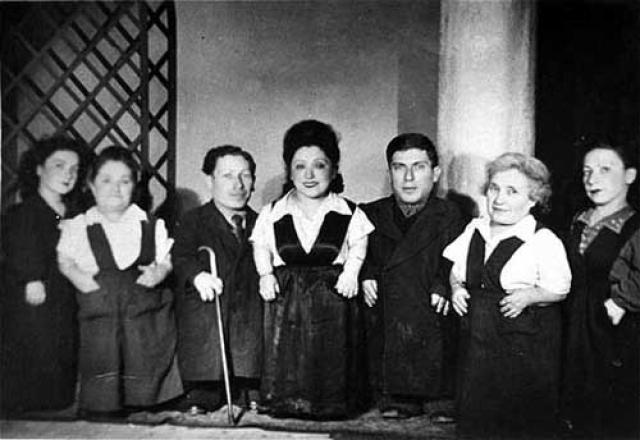
The Ovitz family was a family of Jewish wandering musicians of Romanian descent. They managed to survive the German concentration camp and experiments conducted by the infamous Nazi doctor Josef Mengele.
Origin and Early Life
The Ovitz family resided in Maramureș County, Romania. They were descendants of Shimson Eizik Ovitz (1868–1923), who worked as an actor at Jewish weddings and was a well-known musician. Despite his dwarfism, Shimson managed to marry twice, both times to women of average height. From these marriages, he had ten children, seven of whom inherited dwarfism. In his first marriage to Brana Fruchter, Shimson had two dwarf daughters, Rozika and Franzika. His second wife, Batia Bertha Husz, gave birth to eight children, including Avram, Freida, Micki, Elizabeth, and Perla, who were all dwarfs. Shimson passed away in 1923 when his youngest daughter Perla was not even two years old, leaving his wife Batia to raise the children on her own.

The Musical Family
Recognizing that the dwarf children would face difficulties in life, Batia decided to teach them music from an early age, so they could earn a living. The Ovitz children showed exceptional talent and soon formed a family ensemble, incorporating instruments such as guitar, violin, drums, cello, and more. The entire extended family, not just the dwarf children, participated in their family concerts. Keeping their promise to their mother, the Ovitz children remained close throughout their lives.

The Lilliput Troupe
In the 1930s and 1940s, the 'Lilliput Troupe' began touring Romania, Hungary, and Czechoslovakia. The Ovitz family performed their songs in various languages, including Romanian, Russian, Yiddish, Hungarian, and German. These remarkable dwarf artists were warmly received everywhere they went. Their family orchestra displayed a high level of talent and performance.
Life in Auschwitz
At the outbreak of World War II, there were twelve Ovitz family members, seven of whom were dwarfs. For a long time, they managed to conceal their Jewish background, even obtaining fake documents. However, this could not last forever. On May 12, 1944, all twelve family members were sent to Auschwitz. It is believed that someone informed on them, a common occurrence during that time. The dwarf Ovitz family members immediately caught the attention of the notorious doctor Josef Mengele, who separated them from the rest of the prisoners. The dwarfs became subjects of his medical experiments, as Mengele was particularly interested in genetic abnormalities. They underwent blood tests, hair and bone marrow samples, dental procedures, and were subjected to physical and mental hardships, including public nudity while Mengele delivered lectures.
Survival and Aftermath
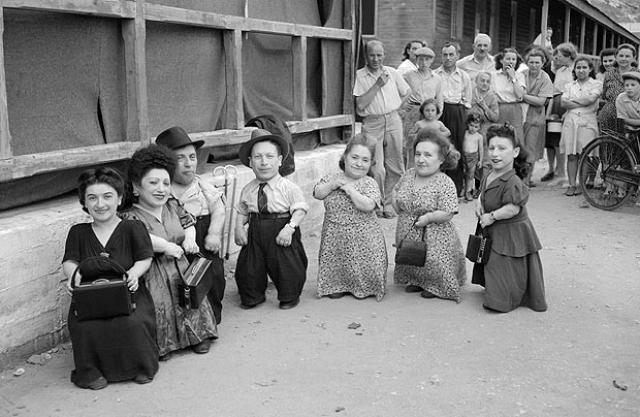
When Mengele was eventually transferred from Auschwitz, mass exterminations began, and the Ovitz family resigned themselves to their fate. However, in January 1945, Auschwitz was liberated, and astonishingly, the entire Ovitz family had survived. This became a remarkable record, as all twelve family members, ranging from 15 months to 58 years old, managed to survive Auschwitz.
After being supported in a Soviet refugee camp for some time, the Ovitz family was released. They embarked on a seven-month journey back to their home on foot. Later, they relocated to Belgium and eventually settled in Israel, specifically in Haifa. They continued to give musical performances throughout their lives.
One by one, the Ovitz family members passed away, with the youngest child, Perla, dying at the age of 80 in 2001. They were buried together, just as they had lived their entire lives - as one big family.