Emma Hamilton
 Great Britain
- Origins and Early Life
- From Emma Hart to Lady Hamilton
- A Political Role at the Neapolitan Court
- Nelson, Public Scandal, and Family
- Debt, Exile, and Death
- Legacy
Emma Hamilton rose from a working-class childhood to become one of Europe’s most recognizable women, celebrated in portraits and theatrical performances before her love affair with Admiral Horatio Nelson made her a figure of national scandal. Her life moved through dazzling public triumphs and private reversals: from the salons of Naples to a final, impoverished exile in France.
Origins and Early Life
Born Amy Lyon on April 26, 1765, in Cheshire, she was the daughter of a blacksmith. Her father died when she was an infant, and she grew up in modest circumstances. As a teenager she went to London, where accounts place her in domestic and theatrical work. She later adopted the name Emma Hart, an early step in reshaping the identity with which she entered fashionable society.
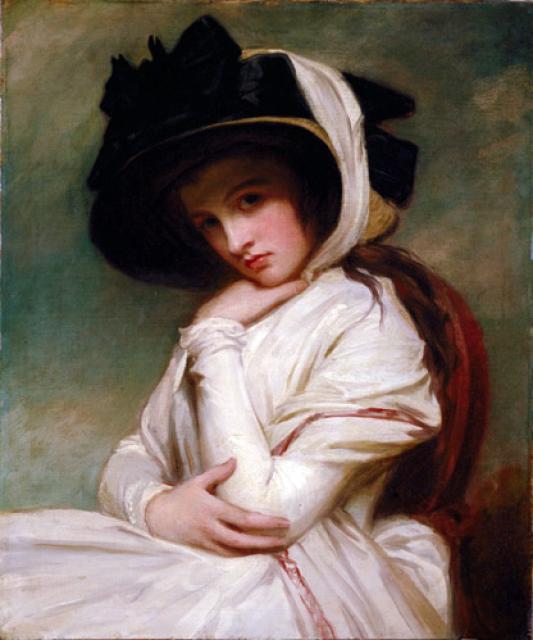
In 1781, she became pregnant after a relationship with Sir Harry Fetherstonhaugh, who left her. Her daughter was raised by relatives while Emma entered the household of Charles Greville, a wealthy aristocrat, as his mistress. Greville introduced her to the painter George Romney in 1782. Romney was captivated by her expressive face and became one of the artists who helped turn her into a celebrated subject. He painted her repeatedly, often as figures from mythology, and his portraits circulated her image among Britain’s cultural elite.
From Emma Hart to Lady Hamilton
Greville’s uncle, Sir William Hamilton, was Britain’s ambassador in Naples and a noted collector and scholar of antiquities. In 1786, Emma went to Naples to join him. She and Sir William married in London in 1791, making her Lady Hamilton and opening the doors of court society that had previously been closed to her.
In Naples she developed a performance style known as the “Attitudes.” Draped in shawls, she moved through a sequence of expressive poses inspired by classical sculpture and paintings, transforming herself into figures from antiquity. The performance blended mime, costume, and visual storytelling. Visitors to Naples came to see it, and artists, including Friedrich Rehberg, recorded her poses in prints. Her modeling and theatrical skill made her a celebrated personality as well as a frequent subject for painters.
A Political Role at the Neapolitan Court
Hamilton became a close friend and confidante of Queen Maria Carolina, whose influence at court gave their relationship political significance. During Britain’s conflict with revolutionary France, Hamilton acted as an informal intermediary between the Neapolitan royal family and British officials. Royal Museums Greenwich credits her with helping secure assistance for the British fleet and using her relationship with the Queen to arrange food aid for Malta in 1799. She was awarded the Maltese Cross for that intervention.
Her influence was also bound up with one of the most controversial episodes in her life. After a French-backed republic was established in Naples in 1799 and the Bourbon monarchy returned, Nelson and the royal authorities took part in the repression of the rebels; many were imprisoned and nearly a hundred were executed. Hamilton supported the Queen’s hard line and was accused by critics in Britain of encouraging the reprisals. Historians have also emphasized how her political activity challenged the expectations placed on women of her time. She was not simply a decorative presence at court, but neither was her influence free of controversy.
Nelson, Public Scandal, and Family
Hamilton first met Nelson in 1793, when his ship arrived in the Bay of Naples. Their relationship deepened after the Battle of the Nile in 1798, when Nelson returned to Naples exhausted and wounded and the Hamiltons welcomed him. Emma helped organize public celebrations of the victory, and her devotion to the admiral soon became as famous as her performances. The affair was openly discussed even though Sir William remained her husband and Nelson’s wife, Frances, was still alive.
The three returned to England in 1800 and maintained an unconventional household, with Nelson frequently away on naval duty. Emma and Nelson had a daughter, Horatia, born in 1801. For years, the child’s parentage was concealed from her, and the adults presented her as an orphan or goddaughter. Sir William died in 1803. Nelson later acknowledged Horatia as his daughter, though the family story remained complicated and Emma continued to avoid publicly identifying herself as the girl’s mother.
Nelson’s death at the Battle of Trafalgar in October 1805 ended their shared future. Before sailing, he had asked the government to provide for Emma and Horatia, but his request was largely ignored. Though the public celebrated the “Nelson and Emma” story, Emma was excluded from his state funeral and received no comparable state support. The contrast between her celebrity and her precarious financial position became increasingly stark.
Debt, Exile, and Death
Sir William had left Emma an allowance, and Nelson left her money and the house at Merton, but her expenses and debts overwhelmed those resources. She tried to maintain the social life and hospitality that had defined her years at the height of her fame. Creditors pursued her, and in 1813 she was confined in the King’s Bench debtors’ prison area. She sold treasured possessions and keepsakes from her life with Nelson to pay what she could.
The publication of Nelson’s private letters in 1814 further damaged her reputation. After leaving prison, she fled with Horatia to Calais, France, to escape creditors. Their money dwindled, and Emma’s health deteriorated. She died in Calais on January 15, 1815, aged 49, with Horatia at her side. The celebrated beauty who had once been painted by leading artists and entertained European visitors was buried far from the society in which she had dazzled.
Legacy
Hamilton’s story has never settled into a single, uncomplicated image. She was a model, performer, and social celebrity whose “Attitudes” made her a sensation; a woman who exercised political influence in a courtly world that rarely admitted women to formal power; and a controversial supporter of a brutal royal crackdown. Her public relationship with Nelson helped turn her into a legend, while the state’s failure to honor his request for her care exposed the fragility of her status. The portraits remain, but the fuller story is one of talent, ambition, political consequence, and a dramatic fall from public favor.