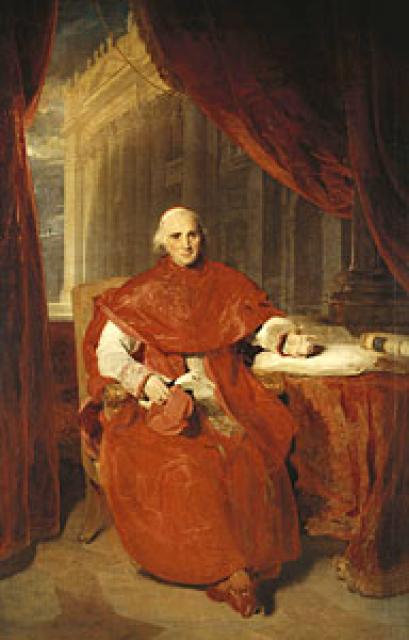
Ercole Consalvi
 Italy
ItalyEarly Life and Education
Ercole Consalvi was born into a noble family in Rome, descendants of the Brunacci family of Pisa. His grandfather, Gregorio Brunacci, inherited the name and coat of arms of the late Marquess Ercole Consalvi of Rome, along with a substantial fortune. After his father's death in 1763, Consalvi was entrusted to the care of Cardinal Andrea Negroni.
He attended the Piarist College from 1771 to 1776, then entered the ecclesiastical seminary in Frascati, founded by Cardinal Henry Benedict Stuart, Duke of York, a pretender to the British throne. Consalvi became a favorite of the cardinal, who helped him secure minor positions in the Roman Curia. From 1776 to 1782, he studied jurisprudence and ecclesiastical history at the Pontifical Ecclesiastical Academy. He continued his legal studies at La Sapienza University, earning doctorates in civil and canon law in 1789.
Diplomatic Career
Consalvi first received a minor post at the papal court in 1784, holding various official positions for the next 14 years. In 1798, with the arrival of the French revolutionary army in Italy, he was imprisoned in Castel Sant'Angelo before being sentenced to deportation to French Guiana. After his release, he joined the exiled Pope Pius VI.
Consalvi's diplomatic skills were recognized, and after Pius's death, he became Secretary of the Council that convened in Venice to elect a new pope. Under the new Pope Pius VII, Consalvi became Secretary of State of the Holy See. He traveled extensively on diplomatic missions, including a crucial role in negotiating the Concordat with France in 1801.
Conflict with Napoleon
Consalvi's anti-Napoleonic stance led to his dismissal as Secretary in June 1806. In 1809, the Papal States were annexed by France, and Consalvi was forcibly taken to Paris. He refused Napoleon's offer of a financial reward and declined to attend his wedding to Princess Marie Louise. Napoleon retaliated by stripping the cardinals of their ranks and property.
The "Black Cardinal" and Restoration
Consalvi remained a "black cardinal" until the fall of Napoleon's empire, when he resumed his diplomatic activities, successfully negotiating several key treaties for the Church. He died in 1824 at the age of 66 and was buried in the Church of San Marcello al Corso in Rome.


