Ernest Dowson
 Great Britain
- Ernest Dawson: Biography of a Talented English Poet
- Melancholic View of the World
- A Tragic Family Background
- A Fragile Spirit
- Deteriorating Health and Addiction
- A Troubled Existence
- A Troubled Spirit
- A Troubled Existence
Ernest Dawson: Biography of a Talented English Poet
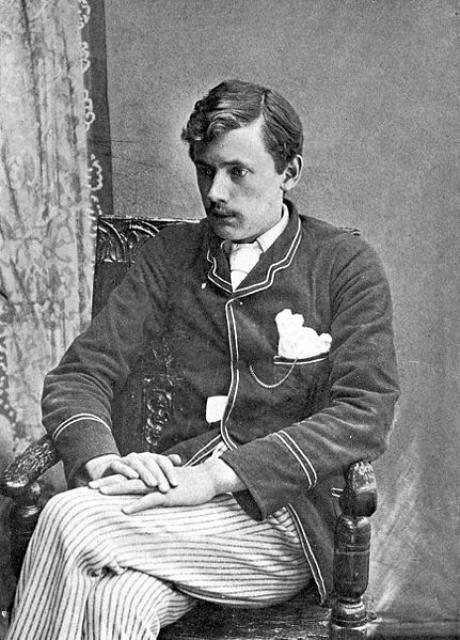
The Tragic GenerationErnest Dawson was one of the most talented English poets at the turn of the century. As a representative of the "tragic generation" of decadents, his poems vividly and accurately expressed the spirit of the 1890s. His melancholy and self-destructive lifestyle, fueled by his excessive addiction to absinthe, became highly mythologized and romanticized, starting with an article published in the "Savoy" magazine in 1896. Arthur Symons found "something interesting in the contrast between his exquisitely refined manners and slightly unkempt appearance" and noted that "he was uncomfortable when there was order around him, or, if you will, he was not himself." He truly experienced the "strange love for the repulsive, so fashionable among the current decadents, but completely sincere in him." One of his friends once said to Dawson that after his death, an inscription reading "Art for Art's Sake" would be found on his heart during the autopsy. His biographer, Jed Adams, wrote that "his dedication to art was simply religious, and he sacrificed his life for it."
Melancholic View of the World
Dawson's melancholic view of the world was connected to his longing for an unattainable ideal and a sense that destruction was inevitable, or perhaps had already occurred. The main themes of his poetry were erotic desire, unrequited or lost love, and separation through death. Influenced by French symbolists and ancient Roman literature, he wrote ruthless poems, but they were not tortured; they possessed a musical lightness. Critics of the time noted his "almost unhealthy grace and refinement, which can only be conveyed through the word 'gracile,' coined by Rossetti, and decadent melancholy." Some of his phrases were almost biblically simple and sonorous; later, they became titles of films and novels like "Gone with the Wind," "Stranger in a Strange Land," and "Days of Wine and Roses." However, if the last phrase seems joyful to us, let us remember the context - "how short you are, days of wine and roses." Dawson was liked by almost everyone who knew him. One of the few exceptions was Aubrey Beardsley. Leonard Smizers commissioned Beardsley to design the cover for Dawson's "Poems," and he adorned it with a question mark. Later, he explained that it meant, "why write this book at all?" Beardsley was sarcastic; he did not like Wilde or Dawson.
A Tragic Family Background
Dawson's father owned a failing dock in East London, which was later renamed "Dawson's Dock" and led to the family's ruin. However, this was not the greatest tragedy in Dawson's life. He fell hopelessly in love with a twelve-year-old girl named Adelaide, nicknamed "Missy," the daughter of a restaurant owner on Sherwood Street in Soho. Dawson had the noblest intentions and patiently waited for this pure image to grow old enough for marriage. When Adelaide grew up, she married a waiter, and Dawson never recovered from the blow. The adoration of little girls was not just a personal quirk; it was the product of the romantic cult of the child, one of the most absurd fashions of the 19th century, which seemed to have an Oxford connection - think of Lewis Carroll. This passion should not be confused with pedophilia in the modern sense; it was devoid of any sensuality. Dawson was deeply disturbed by newspaper reports of a man who ran away with a schoolgirl, secretly lived with her in Hastings, and eventually received six months in prison. "Worst of all," Dawson wrote to a friend in September 1891, "it seems like a dirty and disgusting caricature - ugh, what's the point of looking for phrases? I think you understand what I mean... This vile story has left a sticky residue on my sanctuaries." The cult of the little girl was widespread among decadents, and "Punch," armed with his sensible humor, dealt a powerful blow to this cult by publishing the poem "To Dorothy, My Four-Year-Old Beloved" in September 1894.
A Fragile Spirit
Dawson's friends considered his love for children as a touching testament to the purity of his heart. He himself wrote about the "cult of the child," associating it with the pessimism and disillusionment of the era. He was deeply pessimistic himself, calling the world a "bankrupt enterprise" (a reflection of the unfortunate dock) and life "a play that was bound to fail on the opening night." When a friend reminded him that there were still books, dogs, and seven-year-old girls in the world, Dawson replied that, in the end, books bring melancholy, dogs die, and girls grow up. In the fairly typical poem "Remains," there are the lines: The fire is out, it took the warmth with it (So end all songs on earth), And only sediment remains from wine, Wormwood-bitter, cutting like pain. Love, hope, life forces Have long been lost in the realm of lost things.
Deteriorating Health and Addiction
Jed Adams quotes a fellow student of Dawson's at Oxford, who said that his philosophical pessimism was largely influenced by reading Schopenhauer. "He forever maintained the opinion that nature and humanity are mostly repulsive, and only those writers who cautiously or boldly reveal this truth are worth considering." Certainly, no one ever considered Dawson to be in good health. He wrote to a friend when the dock went bankrupt, "I feel like protoplasm in the embryo of a caveman. If you see a used, spacious, and reasonably priced coffin, please buy it and bring it here." One of the few things that never bored Dawson was alcohol, especially absinthe. "Whiskey and beer are for fools, absinthe is for poets," he said. "Absinthe possesses a magical power; it can destroy or renew the past, cancel or predict the future." In a letter to Arthur Moore in October 1890, he asked, "How is your health? Absinthe, which I drank from nine in the evening until seven in the morning on Friday, seems to have defeated my neuralgia, although to the detriment of my overall health. The soul shifts interestingly when you drink a lot of it! A lively intersection cannot be crossed. How unreal London is to me! How wonderful!"
A Troubled Existence
As a result of his tumultuous life, Dawson's health deteriorated. Another friend of Smizers', Vincent O'Sullivan, author of "The Houses of Sin," recalled Dawson's obsession with his weekly card game with the daughter of a restaurant owner, with whom he played innocently. "This weekly game," writes O'Sullivan, "filled a huge part of his emotional life." He further adds, "When he was sober, he didn't even look at other women, but when he was drunk, he desired any woman, pure or dirty." This was the main theme of his famous poem "Dinahra." The first stanza reads: Yesterday, yesterday, between drunken lips Your shadow fell! Amidst passionate caresses You enveloped my soul with your breath, And you made my evil desire repulsive. In despair, I bowed my head, But I never betrayed you, Dinahra! I remained faithful - in my own way, of course... His past love haunted him constantly, and he could not bury it with prostitutes or debauchery: I demand madness and wine, But the celebration ends, the lantern goes out, And your shadow appears, Dinahra... And the night belongs only to you. Yates writes that one of the members of the Rhymers' Club (possibly Symons) saw a drunken Dawson in a café in Dieppe with a woman whom he disdainfully referred to as an "especially vulgar prostitute" - apparently too repulsive even for Dawson. He grabbed his friend by the sleeve and excitedly whispered that they had something in common. "She writes poetry! Just like Browning and his wife!" Absinthe is mentioned very often in Dawson's letters, which depict the nightlife of the 1890s, sending shivers down one's spine. They usually gathered at the "Cock" tavern on Shaftesbury Avenue with friends. Those who arrived after six would find him there already, drinking absinthe and scribbling poems on scraps of paper or envelopes. Around seven, they would either go to the theater, which Dawson did not particularly enjoy, or to a restaurant on Sherwood Street, where Dawson fell in love with Adelaide. Sometimes things got heavier, like in July 1894, when Dawson drank with actor Charles Goodhart. At that time, Dawson and his friends were helping a sick girl named Mary, possibly an actress, who had taken too much drugs and fell ill with "brain fever," and they were all terribly frightened. We met with Goodhart in the evening. He was accompanied by a charming twenty-year-old opium lover who had run away with his cousin and now planned to marry her. We met at seven, at the "Cock," and drank four absinthes each until nine. Then we went and ate kidneys, and afterward, each of us drank two absinthes at the "Crown" on Charing Cross Road, and there, at Goodhart's club, even more absinthe. So, a total of seven absinthes. It affected us strongly, but not the opium lover. He brought us back to the Temple in a cab. This morning, both Goodhart and I felt distinctly unwell. It can be said that we drowned our sorrow quite well in wine and should confine ourselves to something no stronger than lemonade and strychnine for a few days. But still, we were terribly upset. It's a pity you didn't know Mary better. She was extraordinarily charming and captivated not only men but also women. She won over Missy and her mother instantly, although her mother had no sympathy for flawless brides or anyone else, really. But I must say, I'm damn glad she's gone. Write about your news and forgive my incoherence. My hand is lame, and my head is terribly noisy. Sometimes, such a morning was enough for Dawson to reconsider the green elixir. In February 1899, he titled a letter to Arthur Moore "Whiskey versus Absinthe" and addressed it as if to the "Supreme Court, Department of Strong Drinks." "Generally speaking, it's not worth getting drunk on the green liquid. Its duration of effect is inferior to good old Scotch... I woke up today completely shattered, with a bitter taste in my mouth... As far as I understand, absinthe makes a whore tender. Besides, it ruins the complexion... I've never looked as debauched as I do this morning."
A Troubled Spirit
Dawson's friends considered his love for children as a touching testament to the purity of his heart. He himself wrote about the "cult of the child," associating it with the pessimism and disillusionment of the era. He was deeply pessimistic himself, calling the world a "bankrupt enterprise" (a reflection of the unfortunate dock) and life "a play that was bound to fail on the opening night." When a friend reminded him that there were still books, dogs, and seven-year-old girls in the world, Dawson replied that, in the end, books bring melancholy, dogs die, and girls grow up. In the fairly typical poem "Remains," there are the lines: The fire is out, it took the warmth with it (So end all songs on earth), And only sediment remains from wine, Wormwood-bitter, cutting like pain. Love, hope, life forces Have long been lost in the realm of lost things.
A Troubled Existence
As a result of his tumultuous life, Dawson's health deteriorated. Another friend of Smizers', Vincent O'Sullivan, author of "The Houses of Sin," recalled Dawson's obsession with his weekly card game with the daughter of a restaurant owner, with whom he played innocently. "This weekly game," writes O'Sullivan, "filled a huge part of his emotional life." He further adds, "When he was sober, he didn't even look at other women, but when he was drunk, he desired any woman, pure or dirty." This was the main theme of his famous poem "Dinahra." The first stanza reads: Yesterday, yesterday, between drunken lips Your shadow fell! Amidst passionate caresses You enveloped my soul with your breath, And you made my evil desire repulsive. In despair, I bowed my head, But I never betrayed you, Dinahra! I remained faithful - in my own way, of course... His past love haunted him constantly, and he could not bury it with prostitutes or debauchery: I demand madness and wine, But the celebration ends, the lantern goes out, And your shadow appears, Dinahra... And the night belongs only to you. Yates writes that one of the members of the Rhymers' Club (possibly Symons) saw a drunken Dawson in a café in Dieppe with a woman whom he disdainfully referred to as an "especially vulgar prostitute" - apparently too repulsive even for Dawson. He grabbed his friend by the sleeve and excitedly whispered that they had something in common. "She writes poetry! Just like Browning and his wife!"