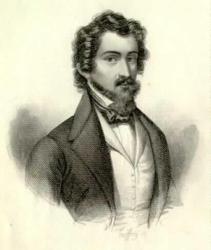
Heinrich Heine
 Germany
Biography of Heinrich Heine
Heinrich Heine, a German poet, was born on December 13, 1797, in Düsseldorf, into a Jewish family. The French occupation brought progressive ideas, including new principles of civil and religious equality, which influenced Heine and made him a "liberal" in the traditions of the French Revolution. He received a mixed education that contributed to the formation of his cosmopolitan worldview.
After attending a private Jewish school, Heine studied at a lyceum where lessons were conducted in French, even by Catholic priests. His attempts to engage in commerce in Frankfurt (1815) and Hamburg (1816-1819) proved unsuccessful. He then studied in Bonn (1819), Göttingen (1820), and Berlin (1821-1823), where he was influenced by Hegel. He eventually returned to Göttingen and obtained a law degree in 1825.
After Prussia deprived Jews of their civil rights in 1823, Heine became a sworn enemy of the Prussian regime. Although he converted to Lutheranism in 1825, his official change of religion did not bring him any advantages, as his writings irritated the authorities more than his religion did. He faced censorship issues with the joint Austrian-Prussian censorship, which plagued him throughout his life.
Literature always occupied a central place in Heine's interests. In Bonn, he became acquainted with A. W. Schlegel and attended his lectures. In Berlin, he was part of Rahel Varnhagen's literary circle. He published his first poems in 1817, and his first collection, "Gedichte" (Poems), was published in 1821. He also ventured into political journalism.
After university, Heine intended to practice law in Hamburg but ultimately chose literary activities and quickly established himself in both prose and poetry. The first volume of his travel writings, "Reisebilder" (Travel Pictures, 1826), which included his journey through the Harz Mountains ("Die Harzreise"), brought him wide recognition, and he earned a living through his literary work. His travel experiences in England (1827) and Italy (1828) provided material for subsequent volumes of "Reisebilder" (1829, 1831). During this time, he also revised his poems and compiled the "Buch der Lieder" (Book of Songs, 1827), which gained recognition, in part because many of the poems were set to music by composers such as Franz Schubert and Robert Schumann.
In 1829, Johann Cotta offered Heine co-editorship of his Munich newspaper, "Neue Allgemeine Politische Annalen" (New General Political Annals). Heine accepted the offer but resigned from the position in 1831, possibly hoping for a professorship (which he did not receive). From then on, Heine was a professional writer. The July Revolution of 1830 provided him with an answer to what he should do next, leading him to leave Germany in May 1831 and settle permanently in Paris. Paris dramatically changed his life, and he rose to new heights as a prose writer and journalist. His articles about France focused on public life, politics, art, and theater, while his articles about Germany covered literature and philosophy. He began with a series of articles about Paris in the Cotta newspaper "Morgenblatt" and continued this work with a series of publications for the same publisher's "Allgemeine Zeitung." The latter articles sparked the displeasure of the Austrian Chancellor Klemens von Metternich and were only fully published as a separate book titled "Franzsische Zustände" (French Affairs). This book was dedicated to criticizing King Frederick William IV of Prussia and urging him to give the promised constitution to the people. Heine's articles on Germany were published in two languages and included works such as "Die romantische Schule" (The Romantic School, 1833) and "Zur Geschichte der Religion und Philosophie in Deutschland" (On the History of Religion and Philosophy in Germany, 1834).
In 1834, Heine met a young saleswoman named Crescence Eugenie Mirat, whom he immortalized in his poems under the name Mathilde. They married in 1841. In 1835, the Prussian Reichstag banned the works of several politically progressive authors from the "Young Germany" movement. Heine's name was listed alongside figures such as Karl Gutzkow, Heinrich Laube, Theodor Mundt, and Ludwig Feuerbach. Unable to gain favor with official Prussia, Heine also had conflicts with the German revolutionary reformers whom Ludwig Börne united around him in Paris. Börne sharply criticized Heine in his "Briefe aus Paris" (Letters from Paris), and Heine was forced to respond. He did so with the work "Ludwig Börne: Eine Denkschrift" (Ludwig Börne: A Memorial, 1840), which received a cold reception in his homeland. In the same year, Heine resumed writing diverse publications about life in Paris for the "Allgemeine Zeitung," which were later compiled into a book titled "Lutezia" (1854). These were his last ventures in journalism as he began to focus on writing poetry, which again took a dominant position in his work. This is evident in the successive publications of "Atta Troll" (1843), "Neue Gedichte" (1844), and "Deutschland. Ein Wintermärchen" (Germany. A Winter's Tale, 1844), which resulted from his trip to his homeland a year earlier and is one of his most powerful works.
By that time, Heine's health had greatly deteriorated. Family disputes following the death of his uncle in 1844 worsened his illness, which confined him to his bed in 1848. However, this misfortune did not put an end to his literary activity. Although his illness turned his life into constant suffering, Heine's creative energy increased immeasurably. This is evidenced by "Romanzero" (1851) and the poems of 1853 and 1854, followed by another posthumously published collection. Heine died in Paris on February 17, 1856, and was buried in Montmartre Cemetery.
Heine's works are easily accessible due to his ability to express complex ideas concisely. He never engaged in extensive controversies, preferring short poems or prose and effortlessly transitioning from one topic to another. While his popularity may not fully reflect his true place in literature, his brilliance lies in his songs (Lieder), which are widely known worldwide. He was not only a natural poet but also a brilliant prose writer, combining the clarity of Lessing, whom he admired, with the genius of Nietzsche, who admired him. Heine's prose in "Das Buch Le Grand" (The Book Le Grand), which tells of the French invasion of Düsseldorf, stands alongside his ballad "Die Grenadiere" (The Grenadiers), dedicated to the same event. Overall, Heine's travel notes provide a vivid picture of his talent, sharp intellect, biting irony, and satirical gift. However, in comparison to the poems he wrote in the last 15 years of his life, everything else fades into the background. As a lyric poet, he achieved unparalleled mastery.