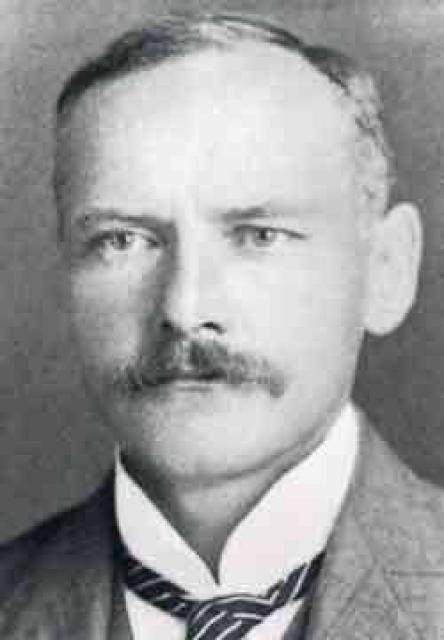
Ernest William Brown
 Great Britain
- Early Life and Education
- Lunar Theory
- Tables of the Motion of the Moon
- Discrepancy with Observations
- Refinement of the Theory
- Other Works
- Honors and Legacy
Early Life and Education
Born in Kingston-upon-Hull, England, Ernest William Brown was the only son of William and Emma Brown (née Martin). He received his early education in his hometown and at East Riding College in East Riding of Yorkshire.
After graduating from high school, Brown enrolled in Christ's College, Cambridge, where he earned a first-class degree in mathematics in 1887. He continued his studies at Cambridge, working under George Howard Darwin.
Lunar Theory
Brown's life's work centered on the theory of lunar motion and the compilation of highly accurate lunar tables. In the summer of 1888, Darwin suggested that Brown examine the papers of George William Hill on lunar theory, which had a profound influence on Brown's future endeavors.
Brown published "An Introductory Treatise on the Lunar Theory" in 1896, demonstrating his extensive knowledge in the field. He went on to develop his own lunar theory, which was published in the Memoirs of the Royal Astronomical Society from 1897 to 1908.
Tables of the Motion of the Moon
In 1907, Brown was appointed professor of mathematics at Yale University. He negotiated the funding from Yale for an extensive project to calculate detailed tables of the moon's motion based on his lunar theory.
After 12 years and an expenditure of over $34,000, Brown published "Tables of the Motion of the Moon" in 1919. His tables were initially found to have discrepancies with observations, but these were later resolved by adding an "empirical term."
Discrepancy with Observations
Despite the accuracy of Brown's tables, observations revealed a small, unexplained fluctuation in the moon's longitude. Brown investigated this issue and concluded that it was due to the retardation of the Earth's rotation. He also discovered that the Earth's rotation was not constant but exhibited irregular fluctuations.
By the mid-20th century, astronomers began to distinguish between Universal Time (UT), based on the Earth's rotation, and Ephemeris Time (ET), an idealized uniform time. The difference between these two times reflects the slowdown of the Earth's rotation.
Refinement of the Theory
Brown's tables were widely adopted for calculating lunar ephemerides until 1983. The advent of computers allowed for direct calculations, which further enhanced the accuracy of the theory.
Other Works
Brown also studied planetary motion. He collaborated with C. A. Shook on the book "Planetary Theory," which discussed planetary orbit resonances and the particular case of Trojan asteroids.
Honors and Legacy
Brown received numerous honors throughout his career, including the Gold Medal of the Royal Astronomical Society (1907), the Royal Medal (1914), the Catherine Bruce Medal (1920), the Gibbs Lecture (1927), and the James Craig Watson Medal (1936).
A crater on the moon and an asteroid (1643) Brown are named in his honor.


