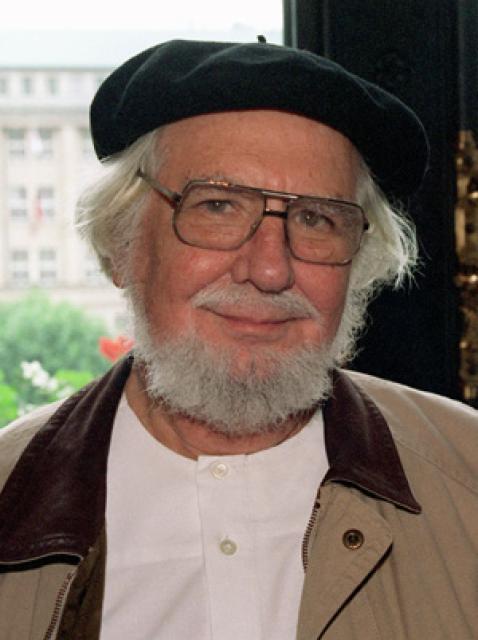
Ernesto Cardenall
 Nicaragua
Biography of Ernesto Cardenal
Ernesto Cardenal is a revolutionary Nicaraguan poet and Catholic priest. He was born on January 10, 1925. He is known for his poetry collections such as "Hour 'O'" (1960), "Epigrams" (1961), "Psalms" (1969), and "In Honor of the American Indians" (1969). Cardenal also wrote books of essays, including "On Cuba" (1972) and "The Gospel in Solentiname" (1975). His poetry is characterized by its lexical diversity, monumentality, and reliance on real facts.
Cardenal came from a wealthy, aristocratic, and conservative family. He received his philosophy and philology education in Mexico and the United States. He traveled extensively throughout Latin American countries and Europe. In 1954, he actively participated in an attempted armed overthrow of the Nicaraguan dictator Somoza. However, the uprising was unsuccessful, and Cardenal immigrated to the United States, where he became a monk.
In 1965, already a renowned writer, Cardenal was ordained as a priest and settled on one of the islands of the Solentiname archipelago in Nicaragua, located in the largest lake in Central America, Lake Nicaragua. There, with a small group of like-minded individuals, he leads a contemplative lifestyle, devoting his time to reflections on the world's fate, handicrafts, communion with nature, and poetry.
Despite his affiliation with the official Catholic Church, religious motifs are minimally present in Cardenal's poetry and in an indirect form. He believes that Latin American poetry prior to his generation was too subjective, too lyrical, and too detached from reality. Following in the footsteps of Vallejo and Neruda, Cardenal proclaims the principle of maximum clarity and comprehensibility of verse to any reader, even the least experienced. He rejects clear distinctions between poetry and prose, believing that anything that can be expressed in a story, essay, or novel can also be said in a poem.
Cardenal's poems often had a social impact. They were distributed as leaflets, publicly recited at political rallies, and even led to police persecution. The poet himself stated, "A poet must be a whole person in every respect and, in this sense, must also be someone who is interested in the problems of his people, politics, and economic conditions, and therefore, take a revolutionary position in his life."
Ernesto Cardenal is considered one of the promising figures of contemporary Latin American poetry. His works, with their profound social consciousness, have become part of the arsenal of revolutionary poetry worldwide.