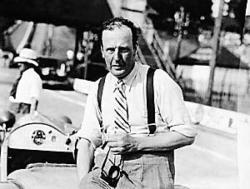
Ernst Heinkel
 Germany
Biography of Ernst Heinkel
Ernst Heinkel, a German aircraft designer, was born on January 24, 1888 in Grunbach, Wurttemberg. He developed an interest in aviation after visiting the International Exhibition in Frankfurt in 1909, and in the same year, he began building his first aircraft, a Farman biplane. In 1911, he made his first flight on this aircraft but suffered a serious accident and sustained severe injuries.
Heinkel worked as a designer for F. Schneider before joining the company 'Albatros Flugzeugwerke'. In 1914, he became the technical director and chief designer of the aircraft manufacturing company 'Ganza und Brandenburgische Flugzeugwerke'. In 1922, he founded his own company and focused on creating seaplanes. He designed and built a catapult for launching seaplanes from ships, which was used in 1927 on the transatlantic liner 'Bremen'.
In the following years, Heinkel created the dive bomber He-50 and the fighter He-51, both widely used during World War II. He also invented the S-3 turbojet engine and the world's first operational jet aircraft, which made its maiden flight on August 27, 1939.
After the war, Heinkel engaged in designing motorcycles and bicycles. Along with Claudius Dornier and Hugo Junkers, Ernst Heinkel's name became synonymous with the revival of German aviation between the two world wars. As a talented designer, Heinkel combined business acumen with the ability to recognize talent in others and create conditions for its development. He left his mark on a quarter-century of aviation history, with his impeccable sense for innovation yielding remarkable results. His style of aerodynamic perfection and clean lines became the standard for global aviation in the 1930s. He also created the world's first successful rocket and turbojet aircraft.
With the rise of the Third Reich, German aviation industry experienced rapid growth, with Heinkel's company playing a significant role. Most of the aircraft that formed the core of the Luftwaffe were designs by Ernst Heinkel GmbH from Warnemunde. Heinkel focused primarily on developing combat aircraft and by the time Hitler came to power, his company was the most experienced in this field.
Ernst Heinkel joined Luft-Ferkers Gesellschaft (LFG) in September 1911 at the age of 24. LFG was located in an old airship hangar in Johannisthal, near Berlin. Shortly after Heinkel's arrival, he became the chief engineer and technical director of the company under the leadership of Swedish engineer Franz Schneider. Working under Schneider, Heinkel created the company's first biplane with a pusher propeller. The aircraft had excellent characteristics for its time and was produced under the designations B-I, B-II, and B-III throughout World War I.
Heinkel left LFG by this time and joined Albatros Flugzeugwerke in Johannisthal in 1913. A year later, he joined the newly founded Brandenburgische Flugzeugwerke, established by Igor Etrich. The control of the company was later taken over by Austrian millionaire Camillo Castiglioni, who appointed Heinkel as the chief designer and changed the company's name to Hansa-Brandenburg Flugzeugwerke GmbH. During World War I, Heinkel produced a series of land and seaplanes, with the most unusual being the folding W-20 aircraft for submarines. The most successful were the two-seat seaplanes, including the W-12 and W-19 built in 1916 and 1917. This line culminated in the creation of the aerodynamically advanced monoplanes W-29 and W-33 in 1917 and 1918.
In 1919, Heinkel's work at Hansa-Brandenburg came to an end. Denmark acquired a license for the W-29, while Norway and Finland were preparing for the production of the W-33. After a two-year hiatus, Heinkel resumed his design work under a contract with Caspar Verke, founded by Karl Caspar in Travemunde. His first project was to create a single-seat cantilever biplane for the U-1 submarine, built for the United States Navy in two examples. Two more were supplied to the Japanese Navy. Additionally, Heinkel, along with Karl Schwarnler, started improving the W-29 and W-33 fighters. At the request of Karl Bucher, who was working in Sweden, Heinkel built a special demonstration aircraft, the S-1, to showcase it to the Swedish Navy. The aircraft's components were transported to Sweden, where they were assembled. The flights were very successful.
The Swedes decided to order a large series of S-1 aircraft, and Bucher suggested building a special factory in Sweden for the production of this aircraft. On May 1922, Heinkel left Caspar Verke and established his own design bureau. Subsequently, he engaged in assembling aircraft at his own Ernst Heinkel Flugzeugwerke in a leased hangar formerly used by the naval testing team in Warnemunde. Initially, the company focused on designing and building prototypes and small series of aircraft. The most successful models were produced at Svenska Aero AB in Lidingo, near Stockholm. The S-1 was built at the Flugkompanie-Verkstader. It was followed by various modifications like the S-2, NE-4, and NE-5, which were produced at Svenska Aero AB and two Centrala Flugverkstader plants. The Heinkel training biplanes ND-24 and ND-36 were also built there. Throughout the 1920s, Heinkel was more known for the variety of his developments rather than the volume of serial production. Despite the small number of orders, the company not only survived but also received several foreign contracts.
In 1925, Heinkel received an order from Japan for a catapult aircraft for the battleship Nagato and for the catapult itself. The order resulted in the production of the biplanes ND-25 and ND-26. Several more orders followed from Japan, including the deck fighter ND-23 and the reconnaissance seaplane ND-28. The catapult, designed on Soviet order, was also installed on the liners Bremen and Europa. In 1927, a license for the biplane ND-22 was sold to the Hungarian company Manfred Weiss. In 1928, Denmark ordered six floatplane monoplanes NE-8 and acquired a license for their production. The NE-8 was also produced under license at the Zmaj factory in Belgrade.
By the late 1930s, Heinkel's company had gained international recognition after the development of the aerodynamically advanced He-70. The following year, when Arado, ATG, Dornier, Focke-Wulf, and Junkers started production of the He-111, a new, large, modern factory was established in Oranienburg. It was built and managed by Heinkel Verke GmbH, a subsidiary that was practically independent, as Heinkel had only invested 3% of the capital. Work at the Oranienburg plant began on May 4, 1936.
During the war, the Heinkel corporation consistently expanded. New factories were established in Vienna and Jenbach, while Hirt Motorenwerke GmbH in Stuttgart and Feriengen Ostwerke GmbH in Krakow were acquired. By the end of 1944, production was taking place at 27 factories, 3 repair workshops, and 12 power stations, employing around 50,000 people, including 26,870 at the factories in Rostock, Oranienburg, and Vienna. Ernst Heinkel passed away in Stuttgart on January 30, 1958.