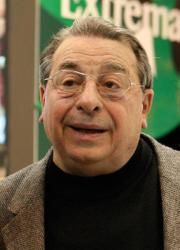
Erwin Axer
 Poland
- Erwin Axer: Polish Theatre Legend
- Directorial Debut and Career in Lviv
- World War II and Warsaw Uprising
- Artistic Director of Contemporary Theatre
- International Recognition
- Teaching and Legacy
- Personal Life
- Artistic Approach
Erwin Axer: Polish Theatre Legend
Early Life and EducationErwin Axer was born on January 1, 1917, in Vienna, Austria, into a prominent Jewish family. His father, Maurycy Axt, was a renowned lawyer and legal scholar, and his mother, Ernestine Schuster, was a homemaker. Axer had an older brother, Alexander Axer, a distinguished Swiss mathematician.
After Poland regained its independence in 1918, the Axer family settled in Lviv. Erwin Axer enrolled in the State Institute of Theatrical Arts in Warsaw, where he studied under famed director Leon Schiller. He graduated in 1939.
Directorial Debut and Career in Lviv
Axer made his directorial debut in 1938 at the Warsaw National Theatre with Eugene O'Neill's "Moon over Caribbee." From 1939, he worked at the Polish Theatre in Lviv, where he staged works by Paul Claudel and August Strindberg.
World War II and Warsaw Uprising
In late 1942, after his father's arrest and execution, Axer moved to Warsaw. He participated in the Warsaw Uprising in 1944 and was subsequently sent to Germany to work in a quarry.
Artistic Director of Contemporary Theatre
After the war, Axer returned to Poland and from 1945 to 1949 served as artistic director of the Chamber Theatre of the Soldiers' House in Lodz. In 1949, the theatre relocated to Warsaw and became the Contemporary Theatre, which Axer led from its inception until 1981. He also briefly headed the combined Contemporary and National Theatres from 1955 to 1957.
Axer focused on contemporary Polish drama and staged plays by Jean-Paul Sartre, Jean Giraudoux, Thornton Wilder, and others. Under his leadership, the Contemporary Theatre became one of Poland's foremost dramatic theatres, renowned beyond its borders. It featured performances by renowned actors such as Andrzej Lapicki and Tadeusz Lomnicki.
International Recognition
From 1962, Axer began directing productions in Vienna, including at the Burgtheater, and in other European cities, such as Berlin, Hamburg, and Zurich. He became known to Russian audiences through his productions at the Leningrad Bolshoi Drama Theatre, including Bertolt Brecht's "The Rise of Arturo Ui", Jerzy Szaniewski's "Two Theatres", and Wilder's "Our Town."
Teaching and Legacy
Axer also taught at the State Institute of Theatrical Arts in Warsaw from 1947. Among his students was renowned Polish director Konrad Swinarski.
In 1992-93, Axer served as a member of the Council for Culture under the President of the Republic of Poland. He was the recipient of the Order of the Banner of Labour (1954), the Leon Schiller Award (1955), and other accolades.
Erwin Axer passed away on August 5, 2012. He left behind a legacy as a versatile and visionary theatre director, renowned for his sensitivity, flexibility, and respect for actors' creativity.
Personal Life
Axer's first marriage was to Bronislawa Kreczmar, an editor at the magazine "Teatr." They had a son, Jerzy, a noted classical philologist. His second marriage was to actress Zofia Mrozowska, with whom he also had a son, American sociologist Andrew Axer.
Artistic Approach
Axer's artistic style was characterized by its eclecticism and respect for different theatrical traditions. He embraced both psychological and experimental approaches, tailoring his methods to the specific play and playwright. While adhering to the principles of Brechtian theatre in productions like "The Rise of Arturo Ui," he also demonstrated a deep understanding of Chekhov's psychological realism.
Axer encouraged actor collaboration and avoided excessive режиссура (undue directorial intervention). His presence was often imperceptible, allowing actors to flourish and create nuanced and compelling performances.