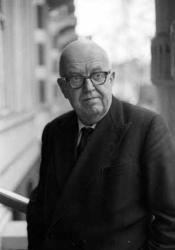
Eugen Barbu
 Romania
- Eugen Barbu: Romanian Novelist and Controversial Figure
- Literary Influence and Works
- Political Affiliation and Scandals
- International Recognition and Controversy
- Ultra-Nationalism and Antisemitism
- Post-Revolution Activities
- Posthumous Allegations
Eugen Barbu: Romanian Novelist and Controversial Figure
Early Life and CareerEugen Barbu was born on February 20, 1924, in Bucharest, Romania. He briefly studied law at the University of Bucharest but later graduated with a degree in philology in 1947. Subsequently, he worked as a journalist for left-wing publications. Barbu was involved with the literary society of "Sburătorul" and made his literary debut in 1955 with his short story "Munca de jos." The following year, he published his first novel, "Balonul e rotund" (The Balloon is Round).

Literary Influence and Works
Barbu's prose is influenced by neorealism and has been compared to the works of Mateiu Caragiale, Tudor Arghezi, and the Italian author Curzio Malaparte. His most famous novels are "Groapa" (The Pit) and "Principele" (The Prince). "Principele," a historical novel set in the Phanariot era, is viewed by critics as an ironic allusion to Gheorghe Gheorghiu-Dej's regime and labor camps for the construction of the Danube-Black Sea Canal.
Political Affiliation and Scandals
Barbu was among the few literary figures who enjoyed the trust of the communist regime during the leadership of Gheorghe Gheorghiu-Dej and Nicolae Ceaușescu, both politically and literarily. He received accolades for his early works that celebrated socialist achievements, such as the Soviet Union's satellite program. Later, authorities encouraged his shift towards nationalism. Barbu was involved in the state censorship apparatus and is alleged to have used this position against his literary rivals.
In 1971, as Romania's period of relative liberalization faded, Barbu became editor of "Luceafărul." He was dismissed after a prolonged conflict with younger writers, which the authorities were eager to accommodate. In the late 1960s, Barbu served as an unofficial envoy for the regime in the United States, tasked with persuading renowned writer and scholar Mircea Eliade to return home, but was unsuccessful.
International Recognition and Controversy
In 1977, Barbu was awarded the international Herder Prize for his literary contributions. However, his multiple terms in the Great National Assembly were overshadowed by a plagiarism scandal, where parts of his novel "Incognito" were found to be nearly identical to texts by Konstantin Paustovsky.
Ultra-Nationalism and Antisemitism
In the 1970s and 1980s, Barbu campaigned against Romanian intellectuals who had sought refuge in the West and writers who criticized the Ceaușescu regime. He also became a proponent of extreme nationalism, and newspapers under his management published derogatory articles targeting the Jewish population.
Post-Revolution Activities
After the Romanian Revolution of 1989, Barbu, along with his protégé, writer and journalist Corneliu Vadim Tudor, co-founded the ultra-nationalist Greater Romania Party (1991). In his later years, Barbu remained a member of the Chamber of Deputies on behalf of Greater Romania. He passed away on September 7, 1993, at the age of 69.
Posthumous Allegations
Eleven years after his death, it emerged that Barbu allegedly engaged in sexual encounters with underage girls facilitated by Tudor. Tudor initially confirmed this but later vehemently denied the accusations against both himself and his mentor.