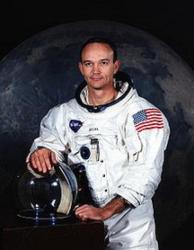
Eugene Cernan
 USA
USABiography of Eugene Cernan
Eugene Andrew Cernan, an American naval officer and aviator, electrical engineer, and astronaut, is best known for being the last person to walk on the surface of the moon. Born in Chicago, Illinois, Cernan grew up in suburbs like Bellwood and Maywood. He graduated from high school in 1952 and attended university, earning a bachelor's degree in electrical engineering in 1956. As part of a program for reserve naval officers, Cernan was called to serve in the Navy. He studied naval aviation and later earned a master's degree in aeronautical engineering in 1963.

Cernan had over 5000 hours of flight time, with more than 4800 hours on jet fighters and over 200 successful landings on aircraft carriers. In October 1963, Cernan was selected as part of NASA's third group of astronauts for the Gemini and Apollo projects. Initially, he served as the backup pilot for Gemini 9 alongside Thomas Stafford. However, after the main crew tragically died in a plane crash, Cernan's backup crew was promoted to the primary crew. The Gemini 9A mission faced its own challenges, with the target vehicle exploding during launch and the backup vehicle being unable to dock due to a protective cover that didn't separate. Nevertheless, the crew successfully completed maneuvers that closely resembled those planned for Apollo 10.

Cernan made history as the second American to perform a spacewalk. However, his spacesuit overheated, causing him to experience a rapid heartbeat. Cernan became one of the three people to have traveled to the moon twice, one of the twelve who walked on its surface, and the only person to have descended to the moon's surface twice in the lunar module. He declined the opportunity to walk on the moon again as the lunar module pilot for Apollo 16, taking the risk of never making it to the moon at all, but he preferred to command his own mission. Cernan later admitted that sending Harrison Schmitt to the moon instead of Joe Engle, the lunar module pilot, was a mistake.

In December 1972, Cernan became the commander of Apollo 17, which was the last moon landing mission. Alongside Schmitt, he spent 22 hours exploring the Taurus-Littrow Valley, completing three extravehicular activities. Their first EVA was more than three times longer than Neil Armstrong and Buzz Aldrin's on Apollo 11. Using the lunar rover, Cernan and Schmitt traveled over 35 kilometers, collecting valuable samples that greatly contributed to our understanding of the moon's history. Cernan drove the rover at a speed of 18 km/h, setting an unofficial record for lunar surface mobility. Before ascending the ladder, Cernan delivered a speech that remains the last words spoken on the moon, expressing his desire to return in the near future.

Cernan left both the Navy and NASA in 1976 and pursued a career in the private sector. In 1999, he co-authored the book "The Last Man on the Moon" with Donald A. Davis, sharing his experiences at NASA and earlier in his life. Cernan also appeared in documentaries such as "Shadow of the Moon" and contributed to the book of the same name. On May 13, 2010, Cernan and Neil Armstrong testified before the U.S. Congress, opposing President Barack Obama's cancellation of the Constellation program, which aimed to return humans to the moon and eventually land on Mars. Unfortunately, the program faced financial difficulties and was ultimately terminated. Eugene Cernan's status as the last human to have walked on the moon remains unchanged, and it is uncertain when or if anyone will follow in his footsteps.