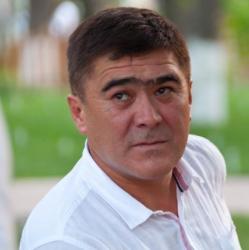
Vladimir Djanibekov
 Uzbekistan
Biography of Vladimir Dzhanibekov
Vladimir Aleksandrovich Dzhanibekov, a twice Hero of the Soviet Union, was a cosmonaut and commander of space crews. He flew on spacecrafts like "Soyuz," "Soyuz-T," and orbital stations "Salyut-6" and "Salyut-7," completing 5 space flights. Dzhanibekov was born on May 13, 1942, in the village of Iskandar (now a settlement in the Bostanlyk district of the Tashkent region in Uzbekistan) in a civil servant's family. He was Russian and became a member of the Communist Party of the Soviet Union in 1970. After graduating from the Tashkent Suvorov Military School in 1960, he initially attended the physics faculty of Leningrad State University. However, a year later, he passed the entrance exams for the Eisk Higher Aviation School and became a cadet. Following his graduation in 1965, he served as a flight instructor in the Soviet Air Force. In 1970, he joined the Cosmonaut Corps and completed the full course of general space training and training for space flights on "Soyuz" spacecraft and "Salyut" orbital stations.
Space Flights and Honors
Dzhanibekov accomplished five space flights as the commander of the spacecraft. His first flight, together with flight engineer Oleg Makarov, took place from January 10-16, 1978, on the "Soyuz-27" spacecraft and the "Salyut-6" orbital research complex. This manned complex in low Earth orbit was created for the first time. The crew returned to Earth on the "Soyuz-26" spacecraft. For the successful completion of this flight and his courage and heroism demonstrated during it, Dzhanibekov was awarded the title of Hero of the Soviet Union with the Order of Lenin and the medal "Golden Star" (No. 11446) by the Presidium of the Supreme Soviet of the USSR on March 16, 1978. From March 22-30, 1981, Dzhanibekov, together with Mongolian astronaut-researcher Zhugderdemidiin Gurragchaa, completed his second space flight on the "Soyuz-39" spacecraft and the "Salyut-6" orbital research complex under the "Intercosmos" program. For the successful completion of this flight, his courage, and heroism, Dzhanibekov was awarded his second "Golden Star" medal by the Presidium of the Supreme Soviet of the USSR on March 30, 1981.
In his third space flight from June 24 to July 2, 1982, Dzhanibekov was the commander of an international Soviet-French crew (flight engineer Alexander Ivanchenkov and French astronaut-researcher Jean-Loup Chrétien) on the "Soyuz T-6" spacecraft and the "Salyut-7" orbital research complex. From July 17-29, 1984, he completed his fourth flight on the "Soyuz T-12" spacecraft and the "Salyut-7" orbital research complex, along with flight engineer Svetlana Savitskaya and astronaut-researcher Igor Volk. Finally, from June 6 to September 26, 1985, Dzhanibekov made his fifth flight on the "Soyuz T-13" spacecraft and the "Salyut-7"-"Soyuz T-13"-"Soyuz T-14" orbital complex. He returned to Earth on the "Soyuz T-13" spacecraft together with Georgi Grechko. In 1985, Dzhanibekov was promoted to the rank of Major General of Aviation.
Later Career and Honorary Titles
From 1988, Dzhanibekov served as the Chief of the Theoretical and Scientific Research Training Department at the Yuri Gagarin Cosmonaut Training Center. He was elected as a deputy of the Supreme Soviet of the Uzbek SSR for the 11th convocation (1985-90). Dzhanibekov received numerous awards and honors, including five Orders of Lenin, the Order of the Red Star, medals, and foreign orders such as the Sukhbaatar Order of Mongolia and the Legion of Honour of France. He is an Honorary Citizen of cities in Russia, including Gagarin, Kaluga, Cherkessk, and Arkalyk (Kazakhstan), as well as Houston (USA). A bronze bust of the twice Hero of the Soviet Union, Dzhanibekov, is installed in the capital of Uzbekistan, Tashkent.