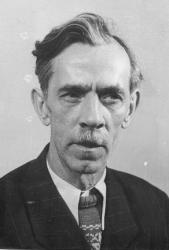
Eugene Delacroix
 France
Biography of Eugene Delacroix
Eugene Delacroix was a French painter, born on April 26, 1798, in Charenton-Saint-Maurice, near Paris. He was known for his choice of heroic subjects in his paintings, such as "Liberty Leading the People: July 28, 1830."
Romantic Art
Delacroix's art represented a complete contrast to the style of Jacques-Louis David and his followers, one of whom, Pierre Narcisse Guerin, was Delacroix's teacher. His first major work, "Dante and Virgil," exhibited at the Salon in 1822, impressed Guerin with its darkness and sharpness of dense shadows, and one conservative critic called the painting "The Massacre at Chios," exhibited in 1824, a destruction of painting. However, both paintings were enthusiastically received by opponents of David's school, and the critics' dispute only solidified Delacroix's fame.
The artist greatly admired the works of English landscape painters, such as J.M.W. Turner and Richard Parkes Bonington. Following the example of Theodore Gericault, Delacroix traveled to London in 1825 to study the paintings of these masters. When Turner's painting "Hay Wain" was presented at a preview before the opening of the Paris Salon in 1824, it made such a strong impression on Delacroix that he repainted the background of his own painting "The Massacre at Chios" in just one day. Several portraits painted by Delacroix during the same period stand out for their transparency of tones and elegance, reminiscent of Thomas Gainsborough's works.
Exotic Themes
The fascination of French artists with exotic Eastern subjects, which arose under the influence of Napoleon's Egyptian campaigns and was later revived during the Greek War of Independence, found reflection in Delacroix's works. Many of his painting subjects were borrowed from the poetry of Lord Byron, including "The Death of Sardanapalus" (1827, Louvre) and "Greece on the Ruins of Missolonghi" (1826, Bordeaux, Museum of Fine Arts). Other motifs are associated with the works of Sir Walter Scott, such as "The Abduction of Rebecca" and "The Crusaders Taking Constantinople" (1840-1841, Louvre). In 1832, the artist traveled to Morocco, and based on the sketches and diary entries made during this trip, he painted "Algerian Women" (1833-1834) and "Jewish Wedding in Morocco" (1839), both housed in the Louvre.
Delacroix never ceased to explore color problems in both theory and practice and laid the foundations for Impressionist painting. He passed away in Paris on August 13, 1863. His murals, created in the Palais Bourbon (1833-1847) and the Luxembourg Palace (1845-1847), as well as in the Church of Saint-Sulpice (1849-1861) in Paris, are among his most famous works. The majority of Delacroix's paintings can be found in the Louvre.