Naum Gabo
 USA
USA- Biography of Naum Gabo
- Early Career
- Life in Europe and America
- Innovative Artistic Approach
- Final Years and Legacy
Biography of Naum Gabo
Naum Gabo was a Russian and American artist, sculptor, architect, and art theorist. He was born Naum Abramovich Pevsner on August 5, 1890, in Bryansk, Russia, into a family of engineers. He was the brother of Anton Pevsner. After graduating from high school in Kursk in 1910, Gabo traveled to Germany, where he initially studied natural and technical sciences in Berlin and Munich. In 1913-1914, influenced by Cubism, he decided to become an artist.
Early Career
In the mid-1910s, while living in Copenhagen and later in Christiania (Oslo), Gabo created his first Constructivist sculptures, signing them with the pseudonym "Gabo". In 1917, he and his brother moved to Moscow, where they published the Realistic Manifesto (1920), urging artists to actively rebuild life rather than passively depict it. Gabo's symbolic figurative sculptures, such as the series "Constructed Heads" (1916), gradually evolved into pure abstractions that combined different materials.
Life in Europe and America
From 1922, Gabo lived in Berlin, where he participated in the First Russian Art Exhibition at the Van Diemen Gallery. He also traveled to the Netherlands and joined the "De Stijl" movement. From 1932 to 1935, he resided in Paris, followed by London in 1935, and finally the United States in 1946. Gabo increasingly identified himself as an art theorist and philosopher. In 1937, he co-founded the journal "Circle" with Ben Nicholson. He advocated for the principles of free form play and moved away from early social utopianism towards pure aesthetics.
Innovative Artistic Approach
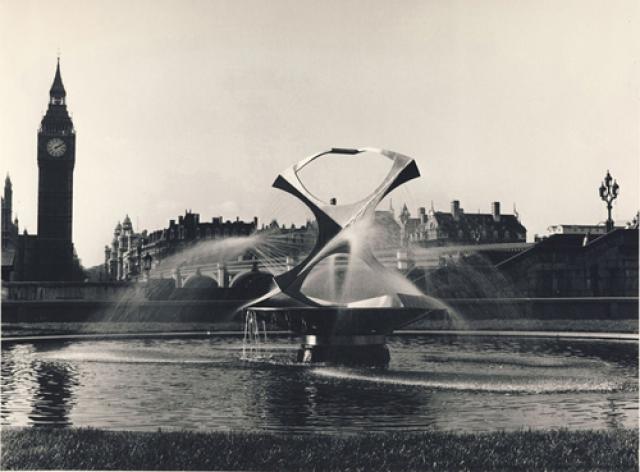
Gabo employed a wide range of techniques and materials in his artworks, including aluminum, steel, bronze, mirrors, wire, nylon thread, and more. He often preferred transparent and semi-transparent forms, embracing the poetics of openings and voids that interacted actively with the surrounding environment. In addition to his museum and exhibition pieces, which were showcased in major contemporary art museums in Western Europe and the United States, Gabo created numerous compositions that synthesized and developed architecture. Notable examples include his constructions and reliefs for the Baltimore Museum of Art (1950-1951), the Rockefeller Center in New York (1956), the Bijenkorf department store in Rotterdam (1956-1957), and the National Gallery in Berlin (1973).
Final Years and Legacy
In 1962, Gabo visited Moscow and Leningrad to meet with his brothers who had remained in Russia. He passed away on August 23, 1977, in Waterbury, Connecticut, USA. Naum Gabo left behind a lasting legacy as a pioneering figure in Constructivist art, pushing the boundaries of sculpture and exploring the relationship between art, space, and the viewer.