Evdokiya
 Russia
- The Holiness of Russian Women
- Early Life and Marriage
- Trials and Tribulations
- The Battle of Kulikovo
- The Invasion of Tokhtamysh
- The aftermath of the Siege
- Regent of Moscow
- The Miracle of the Vladimir Icon
The Holiness of Russian Women
The account of Russian women's sacred spirituality is incomplete and will remain unfinished until our mothers, who tirelessly utter in their fervent prayers, "Glory to God for all things..." cease to exist. Six hundred years ago, the Grand Duchess Eudoxia echoed these words as an advocate for widows, orphans, the marginalized, and the wronged. Her name, like those of many other great Russian women, had been forgotten until recently.
At times, it seems that the contributions of holy Russian women are too commonplace. After all, what could be heroic about the domestic sphere of home, family, husband, and children? With the divine wisdom of the equal-to-the-apostles Princess Olga, the dawn of feminine holiness illuminated Holy Russia, blossoming into the magnificent rainbow of maternal service, prayer, charity, and culminating in the brilliant sunlight of the greatest gospel commandment - to lay down one's life for one's friends.
Early Life and Marriage
Grand Duchess EudoxiaThe virtuous Princess Eudoxia was born in Suzdal, into the pious family of Prince Dmitry Konstantinovich and his wife Anna. It was within her paternal home that the young princess learned to prioritize the salvation of her soul and to observe God's commandments. Here, she also grasped that her grand-ducal status was not a license for idleness or indulgence, but a momentous and burdensome service to God, country, and people, and that she should spare her heart for none. Throughout her life, Grand Duchess Eudoxia would indelibly demonstrate the extent to which she had absorbed her father's teachings.
In 1366, Princess Eudoxia was betrothed to the Grand Prince of Moscow, Dmitry, who would leave an indelible mark on Russian history as Dmitry Donskoi, the victor over the Tatars. The young bride's devout temperament and piety immediately resonated with the virtuous Dmitry; their marriage spanned 22 years and became a model of a virtuous union.
Eudoxia's marriage coincided with years of hardship for Moscow, as the growing young state endured constant enemy attacks. In the princess's own words, she experienced "few joys in marital life with Dmitry." The Grand Duchess witnessed the invasion of Moscow by the Lithuanian prince Olgerd, who had earned a reputation as a cruel and relentless ruler. His military campaigns evoked memories of Batu Khan's devastating raids. Moscow also grappled with various epidemics and natural disasters. Shortly after the wedding, an unprecedented fire erupted, leaving an everlasting impact on the city, followed by a plague. The compassionate princess's heart was torn with grief and suffering. She became a beacon of solace and support for her people. Eudoxia used her own funds to bury the victims of the Moscow fire and generously provided aid to the victims. She could often be found in the Kremlin cathedrals, fervently praying to the Lord for mercy upon her afflicted nation.
Trials and Tribulations
The great intercessor faced a series of trials, including Olgerd's renewed invasion of Moscow and the wars with the Ryazan princes Oleg and Mikhail Tverskoy. These experiences forged the spiritual growth of Moscow's future saint. She shed all vanity and trivialities, learning to endure great sorrows in silence and humility. The princess's Christian virtues multiplied, and she became known as the mother of Muscovy.
No matter how arduous or turbulent Dmitry Donskoi's reign, he succeeded in strengthening the Muscovite principality. Could it be attributed to the presence of Grand Duchess Eudoxia by his side - a woman of unwavering faith, quiet strength, and determination, who diligently protected her family and children? This serves as a profound lesson for those who underestimate the significance of a wife's role as a helpmate to her husband.
The Battle of Kulikovo
Grand Duchess Eudoxia's most formidable trial was yet to come: the Battle of Kulikovo. Blessed by Sergius of Radonezh, Dmitry prayed fervently before the relics of his great ancestors in the Cathedral of the Archangel Michael. His unwavering companion, Princess Eudoxia, stood by his side in prayer. Throughout the battle, she continued to pray - as a Grand Duchess, as a loving wife, mother, and woman.
At the same Frolovsky (now known as Spassky) gates where she had bid farewell to her husband as he left for battle, Princess Eudoxia welcomed him back victorious! Moscow's joy was short-lived, and its peaceful existence was cut short. A new storm was brewing over Russia.
The Invasion of Tokhtamysh
The embittered Tokhtamysh devised a cunning plan to punish Moscow and subjugate it once more. He stealthily dispatched a vast army toward Moscow. His stratagem succeeded, and Dmitry realized the impending Tatar invasion far too late. Leaving Moscow and his family in the care of the metropolitan, Dmitry retreated to Kostroma to gather forces. Only a small number of devout individuals, led by Princess Eudoxia, imposed strict fasts upon themselves, repented their sins, fervently prayed to God, and received communion. The city descended into chaos. The Grand Duchess herself narrowly escaped Moscow. Upon hearing of her escape, the Tatars gave chase. It was only through the intercession of the Most Holy Theotokos that Princess Eudoxia, who had nearly been apprehended, managed to reach her husband in Kostroma. Meanwhile, an innumerable horde of Tokhtamysh's troops besieged the Kremlin walls.
The defenders of Moscow fought valiantly. However, through deception and treachery, the Tatars gained entry into the Kremlin. A massacre ensued. "In what words," the chronicle describes, "can we depict the scene of Moscow at that time? This teeming capital had formerly abounded in wealth and splendor: in one day its glory perished; nothing remained but smoke and ashes, bloodstained earth, corpses, and empty charred churches. The dreadful silence of death was broken only by the stifled groans of some of the victims, who, though hacked by the sabers of the Tatars, still retained life and feeling." This heinous crime occurred on August 26, 1383.
The aftermath of the Siege
Grand Prince Dmitry, upon returning to his devastated hometown with Princess Eudoxia, wept amidst the ruins of his city, reduced to ashes. The prince and princess jointly buried 24,000 people at their own expense. If the Grand Prince himself, a husband and warrior, could not contain his tears in public, what emotions must his virtuous wife have endured? Did she weep? Most likely not, for her anguished soul and wounded heart had already borne unfathomable grief, and her tears for her homeland had long been spent. As the comforter of the destitute and the afflicted, she could not afford to be weak. Her emotions were reserved for herself and the Most Holy Theotokos, to whom alone she entrusted her sorrows in the dead of night.
Tokhtamysh, insatiable in his devastation of Moscow, demanded Dmitry's presence in the Horde. The mission fell upon his eldest son, Vasily, who was merely thirteen years of age. However, youths matured rapidly in those times, and Vasily knowingly accepted his destiny in the Horde. The demands of the state necessitated his sacrifice: Moscow, having endured a harrowing tragedy, could not remain without a Grand Prince. This epitomizes the true destiny of a prince - to spare neither his own life nor the lives of his children for the sake of his homeland.
Vasily remained a hostage in the Horde for two long years. His mother did not utter a single word of protest against his departure - such were her father's teachings and instructions. The maternal anguish did not embitter Grand Duchess Eudoxia; she remained as attentive to widows and orphans as before, only intensifying her nightly prayers for her son.
Vasili managed to escape from the Horde. Upon his return to Moscow, he found his father gravely ill. Before his passing, Dmitry dictated his spiritual testament, instructing his sons to obey their mother in all matters, to act unanimously, to cherish their homeland, and to honor its loyal servants: "My children, live together in harmony, obey your mother in everything, and do not deviate from her will in any way. Any son who disobeys his mother shall be deprived of my blessing..."
Regent of Moscow
Princess Eudoxia had lived in the shadow of her husband's glory, and there is little information about her life. Now, she had to face the reality of sharing with her son Vasily the burdens of ruling. She became the head of the large family and the ruler of the Moscow Principality.
In memory of her husband, she commissioned the Church of the Nativity of the Virgin in the Moscow Kremlin. The Grand Duchess thus fulfilled a long-standing vow to express her gratitude to the Most Holy Theotokos for her aid to the Russian forces in the battle against Mamai. On that occasion, Princess Eudoxia had initiated the solemn celebration of the Victory at the Battle of Kulikovo. Six hundred years ago, the Grand Duchess foresaw the significance of this day for Russians!
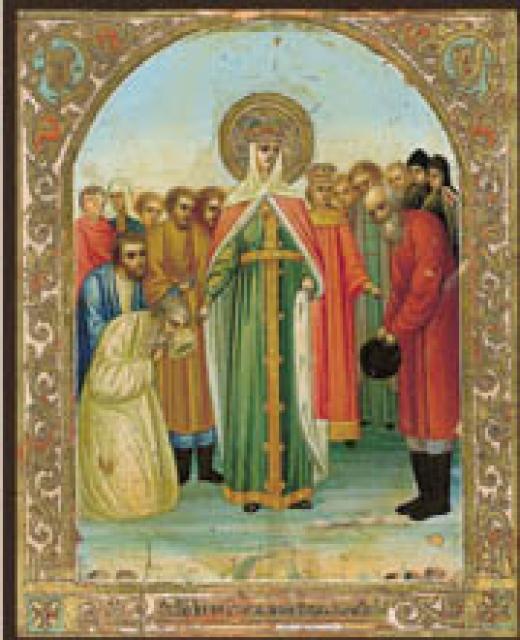
Grand Duchess Eudoxia honorably fulfilled her role as a widow and sovereign, wisely governing Muscovy. However, succumbing to temptation, the people began to slander and disparage her, accusing her of seeking male favor. These unjustifiable remarks troubled her sons. In response, the Grand Duchess, unwilling to tempt her sons into condemning their mother, secretly summoned them and shed the layers of luxurious royal garments before them. To their horror, they beheld the blackened and emaciated body of their mother, ravaged by toil and fasting. They prostrated themselves, begging their mother's forgiveness. She sent them away in peace, instructing them: "My children, never trust appearances. God alone is the judge of human actions."