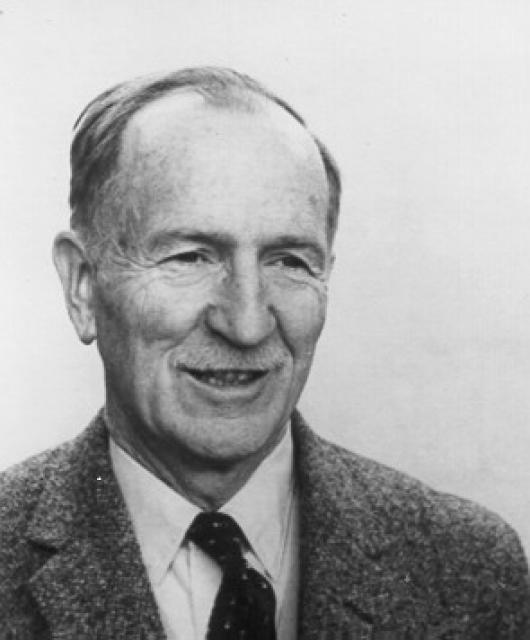
Everett Hughes
 USA
USA- Biography of Everett Hughes
- Early Career and Research
- Contributions in Germany and Canada
- Later Career and Legacy
Biography of Everett Hughes
Everett Hughes was an American sociologist who belonged to the Chicago School of Sociology and was known for his work on issues of ethnic relations, occupations, employment, and data collection methodology. His approach to sociology was very broad and intersected with many related disciplines. In recent research, Hughes' theoretical contribution to sociology is considered as interpretive institutional ecology.
Early Career and Research
Born on November 30, 1897, in Ohio, Everett Hughes was the son of a Methodist minister from a farming family. He studied Latin, French, and German at Ohio Wesleyan University and moved to Chicago, Illinois in 1917. For five years, he worked as an English teacher for immigrants from various nationalities arriving in the United States.
In 1923, Everett enrolled in the Department of Sociology and Anthropology at the University of Chicago, studying under the guidance of renowned scholars such as Robert Ezra Park, Ernest Burgess, Ellsworth Faris, and Robert Redfield. However, Hughes considered Robert Park as his main mentor. He continued working as a director of a public park, allowing him to interact with and study diverse immigrant communities. In 1927, he obtained his master's degree, and the following year, he successfully defended his doctoral dissertation.
Contributions in Germany and Canada
Hughes spent one year in Germany from 1930 to 1931, collecting material for his research on the Catholic labor movement. He returned to Germany after the end of World War II, along with a large delegation of American scholars. Fluent in German, these trips resulted in two of his classic works, 'Good People and Dirty Work' and 'The Gleichschaltung of the German Statistical Yearbook: A Case in Professional Political Neutrality'. It is interesting to note that he was one of the first sociologists to analyze events occurring in Nazi Germany.
Hughes also had a great interest in Canadian society, and his excellent command of the French language allowed him to develop and maintain connections with Canadian francophone sociologists. He played a significant role in the early period of Canadian sociology.
Later Career and Legacy
In 1938, Hughes returned to the University of Chicago and became one of the leading scholars in the Department of Sociology. In 1961, he accepted a position as a sociology professor at Brandeis University in Waltham, Massachusetts, where he co-founded the Sociology Department. Seven years later, he moved to Boston College. From 1952 to 1961, Hughes served as the editor of the 'American Journal of Sociology', and in 1963, he was elected as the 53rd president of the American Sociological Association.
Throughout his career, Hughes provided guidance and mentorship to students at Boston College. He continued to consult students until the last years of his life. Everett Hughes passed away on January 4, 1983, at the age of 85, due to Alzheimer's disease, at Mount Auburn Hospital in Cambridge, Massachusetts, where he resided.




